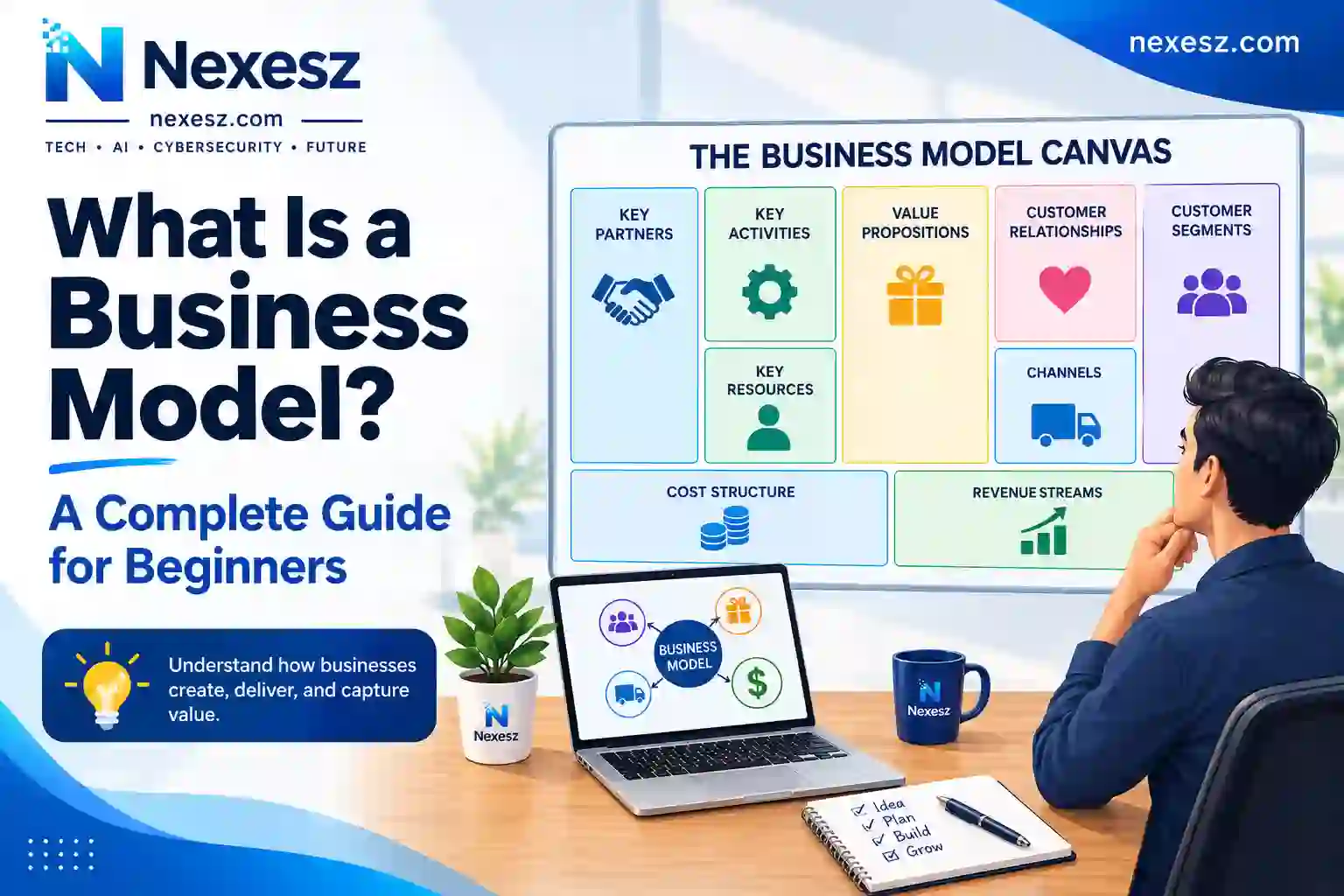
Every company, from a one-person freelance operation to a global tech giant, runs on some version of the same question: how does this business actually make money? That question, answered clearly, is what a business model is in practice.
Understanding this concept properly, before you build a product or write a single line of a business plan, saves founders from the expensive mistake of building something nobody will pay for.
This guide covers the definition, real examples, the major types, and how a business model connects to (and differs from) a full business plan.
By the end, you’ll be able to look at any company — including your own idea — and clearly explain how it actually makes money, which is the whole point of understanding what a business model is in the first place.
What Is a Business Model?
A business model is the basic logic of how a company creates value, delivers it to customers, and earns revenue in return. It’s less about the product itself and more about the mechanics behind the sale.
At minimum, a business model answers four questions: who is the customer, what value are they getting, how is that value delivered, and how does money flow back to the business.
A business can have a great product and still fail if the underlying model doesn’t work — if delivery costs more than the price customers will pay, for instance.
This is different from strategy or marketing, which come later. The model is the foundational logic; everything else is built to support it, refine it, or communicate it to the right people.
Seeing It in Practice: Real-World Examples
Seeing a few real examples makes the concept click faster than any definition alone.
Netflix charges a flat monthly subscription for unlimited streaming access, rather than charging per movie watched — the entire value proposition depends on that pricing choice.
Amazon operates as a marketplace and retailer combined, earning from direct product sales, third-party seller fees, and its cloud computing arm (AWS) all under one company.
A local bakery runs on a straightforward product-based model: make goods, sell them at a markup covering ingredients, labor, and rent.
A freelance consultant sells expertise directly, charging by the hour or by project, with almost no inventory or overhead beyond their own time.
Each one above solves the same core questions differently, based on what actually fits the product and customer.
The Main Categories You’ll Encounter
Most businesses fall into one of several well-established categories, though many combine more than one.
B2B (business-to-business) models sell to other companies rather than individual consumers — software, wholesale supplies, and consulting services often fall here.
B2C (business-to-consumer) models sell directly to individual buyers, covering most retail, ecommerce, and consumer apps.
D2C (direct-to-consumer) brands skip traditional retailers entirely, selling straight from manufacturer to customer, usually online.
Product-based models sell a physical or digital good once per transaction, while service-based models sell time, expertise, or ongoing work instead of a tangible item.
Subscription-based, marketplace, freemium, affiliate, and SaaS (software-as-a-service) models round out the most common categories, each with its own revenue timing and customer relationship.
A marketplace model, like Etsy or Airbnb, doesn’t sell its own products at all — it earns a commission connecting buyers and sellers. A freemium model offers a free basic tier while charging for premium features, common across apps and software. An affiliate model earns commission promoting other companies’ products, which our guide on affiliate programs for beginners covers in more depth.
Understanding these different types of business models helps you spot which existing pattern your own idea most closely resembles, rather than inventing one from scratch.
Starting Simple as a Beginner
You don’t need something complicated to start. A simple business model for a beginner usually looks like: one clear customer, one clear offer, one clear price.
A freelance graphic designer charging a flat fee per logo is a good example. So is a single digital product sold once on a personal website with no subscription, no tiers, and no complex funnel.
Complexity can come later, once you understand what customers actually respond to. Starting simple also makes it far easier to test whether the core idea works before adding moving parts.
If you’re still unclear on what the business model is in your specific case, try writing it in one sentence: “I sell [what] to [who] for [how much], delivered through [how].” If you can’t fill that sentence in clearly, the model likely needs more thought before you build anything.
What Is the Difference Between Business Model and Business Plan?
These two terms get used interchangeably, but they’re not the same thing.
A business model is the core logic — how the company makes money. A business plan is the full document: market research, competitive analysis, marketing strategy, financial projections, and operational details, all built around that model.
Think of the business model as the engine and the business plan as the entire vehicle built around it. You generally need to know your model before a business plan means anything, since the rest of the plan gets built on top of it.
Your business structure also connects here — how you legally register the company affects taxes and liability regardless of which model you choose. Our guide on choosing the right small business structure covers that side of the decision separately.
A useful way to remember the distinction: you can sketch a business model on a napkin in five minutes, but a proper business plan usually takes days or weeks to put together properly, since it needs research and numbers behind every claim.
Mapping It Out With a Business Model Canvas
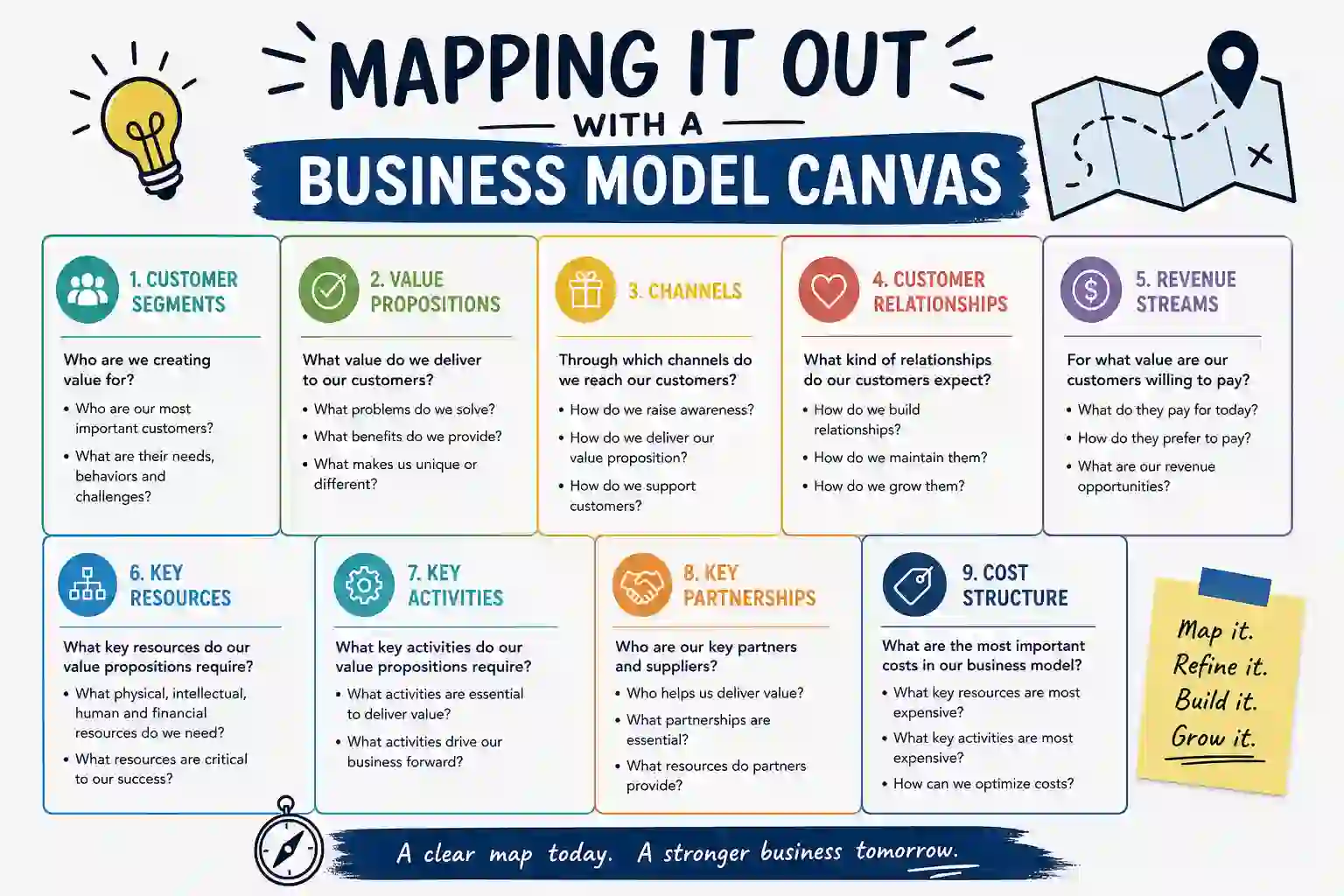
The Business Model Canvas, developed by Alex Osterwalder, is a one-page framework for mapping out a business model visually instead of writing pages of text.
A filled-out example of a business model canvas typically includes nine blocks: customer segments, value proposition, channels, customer relationships, revenue streams, key resources, key activities, key partners, and cost structure.
For a simple online course business, the canvas might show: customer segments as “beginners in X skill,” value proposition as “learn X faster than self-teaching,” channels as “social media and email,” and revenue streams as “one-time course purchase.”
The canvas format is popular precisely because it forces founders to think through all nine areas at once, rather than obsessing over the product while ignoring distribution or cost structure. Strategyzer, the company behind the framework, offers free templates if you want to try filling one out for your own idea.
Recurring Revenue: The Subscription Approach
A subscription business model charges customers a recurring fee — usually monthly or annually — for ongoing access to a product or service, rather than a single one-time payment.
Streaming services like Netflix and Spotify are the most familiar examples, but the model extends to software (SaaS), subscription boxes, membership sites, and even physical products delivered on a recurring schedule.
The appeal for businesses is predictable, recurring revenue instead of needing to find a new customer for every single sale. The tradeoff is that customers can cancel at any time, so retention becomes just as important as acquisition.
Understanding what a subscription business model is matters because it changes how you measure success — metrics like churn rate and customer lifetime value matter more here than in a one-time-purchase model. A business earning $10,000 from one-time sales and $10,000 from subscriptions can look identical on paper this month, but the subscription revenue is far more predictable for planning next month.
Service-Based Business Examples
Not every business sells a physical or digital product. Service-based businesses sell time, expertise, or labor directly.
Common service-based business examples include consulting, freelance writing or design, accounting, legal services, coaching, home repair, and digital marketing agencies.
These businesses often have lower startup costs than product businesses, since there’s no inventory or manufacturing involved. The tradeoff is that revenue is usually tied directly to hours worked, unless the business builds packaged offers or hires additional people to scale delivery.
Many service businesses eventually add productized elements — templates, courses, or software — to create revenue that doesn’t require trading more hours for more income.
This shift is common enough that it’s worth planning for from the start. A consultant who packages their process into a repeatable framework, or documents it as a course, builds a path toward revenue that scales beyond their own available hours.
Choosing the Right Model for Your Situation
With so many options, the right choice usually comes down to three things: how you want to deliver value, how predictable you need revenue to be, and how much you’re willing to trade time for money versus building something scalable.
A beginner with limited resources often starts with a simple, service-based model and evolves toward subscription or product-based revenue as the business matures.
There’s no universally “best” model — only the one that fits your specific skills, market, and goals at this stage of the business. Revisiting your business model for your situation every year or two, as the business grows, is normal and often necessary.
Conclusion
At its core, what a business model is comes down to one clear question: how does this company actually make money? Everything else — the plan, the marketing, the operations — gets built around that answer.
Start with a model simple enough to explain in one sentence, test it against real customers, and let the details evolve as you learn what actually works.
FAQs
1. What is a business model in the simplest terms?
It’s the basic explanation of how a company creates value for customers and earns revenue from that value in return.
2. Can a business have more than one business model?
Yes. Many companies combine models — Amazon, for example, runs retail, marketplace, and subscription (Prime) models simultaneously.
3. Is a business model the same as a revenue model?
They’re closely related but not identical. A revenue model specifically describes how money is collected, while a business model includes the broader value creation and delivery process too.
4. What’s the easiest business model for a complete beginner?
A simple service-based model, like freelancing a single skill for a flat fee, typically requires the least setup and capital to test.
5. How do I know if my business model actually works?
The clearest signal is real paying customers. A model that sounds good on paper but generates no actual sales usually needs to be revisited before scaling anything else.
Leave a Reply