
Here’s a number that should encourage you: the U.S. marketing agency market hit $192.45 billion in 2026, and there are now more than 71,000 digital agencies across North America. But the second number matters more — 87% of them have fewer than 50 employees. Most of the industry is tiny, and that’s exactly why this works for a solo founder.
When people ask me how to start a digital marketing agency, I don’t start with pitch-deck talk. This guide covers the whole path step by step — what to sell, who to sell it to, what it costs, and how to land your first clients. No office, no big team, no six-figure budget.
What Is a Digital Marketing Agency
A digital marketing agency is a business that runs marketing for other businesses online. Instead of hiring a full in-house team, a company pays an agency to handle search, social, content, email, or paid advertising.
The core digital marketing agency services are search engine optimization, social media management, content marketing, email marketing, PPC advertising, web design, and conversion rate optimization. You don’t have to offer all of them — most small agencies lead with one or two. Demand for these services keeps climbing, as more buyers search, scroll, and click instead of walking in.
Two numbers frame the industry. Digital channels now take the majority of agency revenue — 61.6% in 2026, up steadily for a decade. And the “industry” is made up of small teams: the average digital agency has fewer than 10 full-time employees, and 87% have under 50. A two-person shop is not a struggling agency. It’s the norm.
If you’re new to the space, it helps to start with what digital marketing actually covers before you pick a specialty.
Why 2026 Is the Right Year to Start
Three numbers tell you why now:
- $192.45 billion — U.S. marketing agency market in 2026, growing at 5.46% a year toward $251 billion by 2031 (Mordor Intelligence)
- 72% of small-business marketing budgets now target digital channels
- 9 in 10 U.S. agencies use generative AI, and 79% say it saves them at least five hours a week (Forrester/4A’s, AgencyAnalytics)
The catch is in the fine print. Worldwide ad spending grew 8.6% in 2025, yet agency holding-company revenue fell 1.2% (eMarketer). The money is still flowing — it’s just leaving execution-only shops that sell hours and deliver generic campaigns.
That’s the whole strategy in one line: start narrow, sell outcomes, and use AI to deliver at a quality level a five-person team used to produce. I’ve watched this exact gap open since 2024. The clients are still there; only the boring agencies are disappearing.
Step 1 — Learn the Services You’ll Actually Sell
Most guides on how to start a digital marketing agency say “learn everything.” In practice, that spreads you thin across five skills and leaves you good at none of them.
Pick one or two lead services:
- SEO — the longest sell, the stickiest revenue
- Social media management — the fastest onboarding
- Content marketing — pairs naturally with SEO
- Email marketing — small retainers, easy wins
- PPC advertising — fast results, but you’re managing the client’s budget
You don’t even have to start a social media marketing agency with a social background — a content or SEO person can add posting and community management in a few weeks of practice.
The way to build real skill is the same way I built mine: run the services on your own website, a personal project, or a small business that will trade a free month for a case study. Three weeks of running a real account teaches more than three months of courses, and it gives you proof to show future clients.
Step 2 — Choose a Profitable Niche
Choosing a niche is where most new agencies quietly decide their price ceiling.
Common niches that work well for a solo founder:
- Local service businesses (dental, legal, HVAC, med spas)
- E-commerce stores
- Real estate teams
- Healthcare and wellness
- Restaurants and hospitality
- SaaS and B2B services
A niche does three things: it makes your pitch specific (“I rank dental practices in one state” beats “we do SEO”), it lets you build one system and reuse it, and it creates referral loops inside the industry.
Treat your niche like a product, not a preference. The service-based business model logic applies directly — the more productized the offer, the easier it is to price, sell, and scale. In my experience, niche agencies close faster and charge more, because the client can picture the result before the first call ends.
Step 3 — Write a Simple Business Plan and Set Your Pricing
A digital marketing agency business plan does not need to be a 40-page document. It needs six answers:
- Who exactly is the client?
- Which one or two services will you sell?
- What is your price, and why?
- Where will the first five clients come from?
- What does a good month look like?
- What do you add next year?
Pricing is where beginners undercharge. 2026 benchmarks for what agencies actually charge:
- SEO retainers — $1,500–$7,500 per month for most small businesses
- Social media management — $500–$5,000 per month depending on platforms
- PPC management — 10–20% of ad spend, or $500–$5,000 flat
- Hourly work — $75–$300+ per hour
Two more numbers to know before you set your price. The average digital agency earned a 13% after-tax margin in 2025 — but small studios under 10 people earned 19%. And in 2026, 38% of U.S. agencies moved at least one service to retainer-plus-performance pricing, because clients are pushing back on hourly billing.
My rule: price at the low end of the market, never below it. You can raise prices after two happy clients. You can’t untrain a client to expect cheap.
Step 4 — Build Your Website and Portfolio
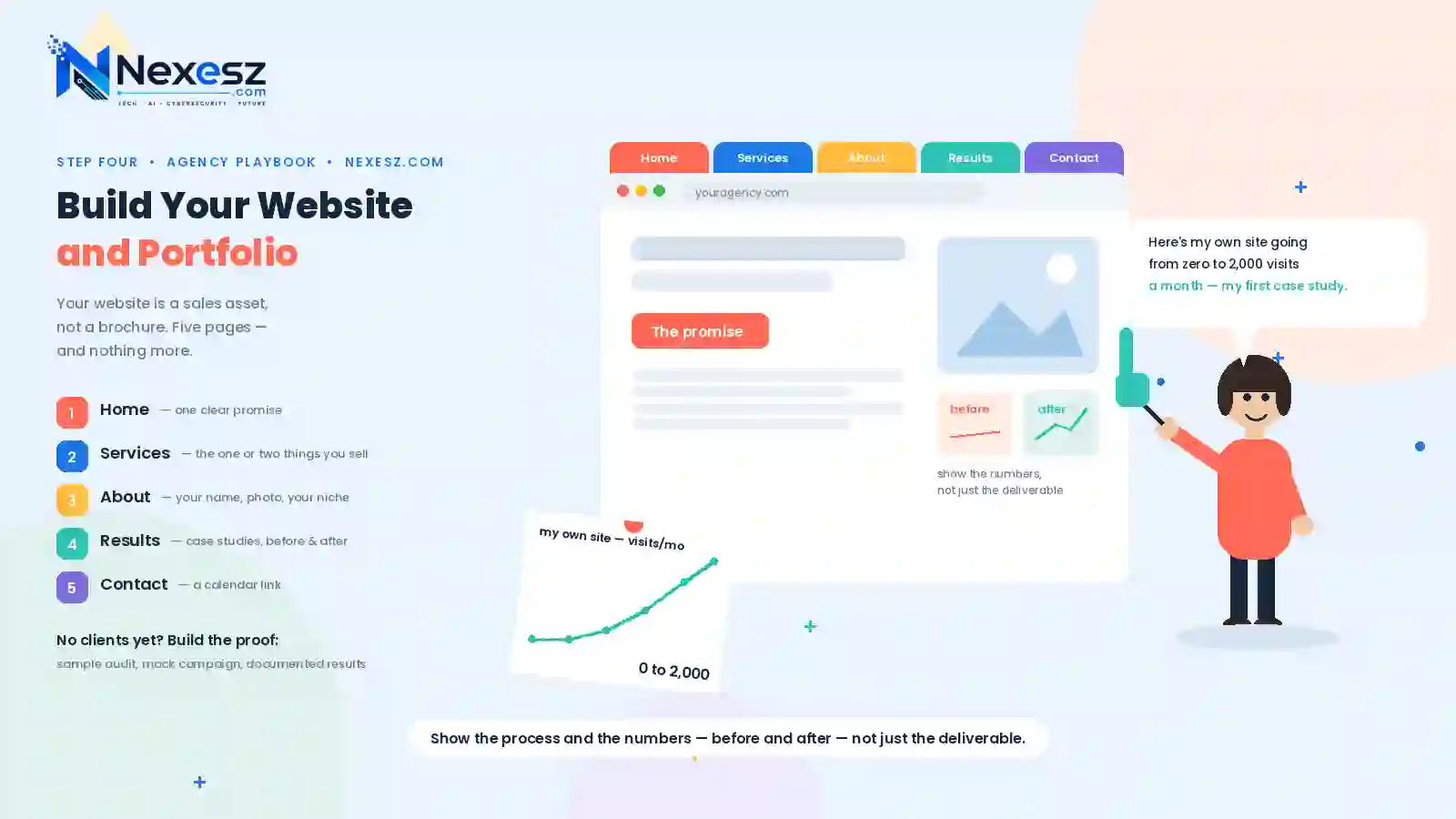
Your website is a sales asset, not a brochure. It needs five pages and nothing more:
- Home page with one clear promise
- Services page describing the one or two things you sell
- About page with your name, photo, and why you picked this niche
- Results or case studies page
- Contact page with a calendar link
If you have no clients yet, build the proof anyway. Run a free SEO audit on a sample site, create a mock campaign for a made-up business, or document a real campaign you ran for a friend. Show the process and the numbers — before and after — not just the deliverable. Good freelance portfolio examples follow exactly that pattern.
Then make the site itself your first case study. The same discipline that makes high-quality content rank applies to your own pages: publish consistently, target real keywords, and screenshot the traffic graph every month. “Here’s my own site going from zero to 2,000 visits a month” is the most believable line in any agency proposal I’ve ever written.
Step 5 — Get Your First Clients
The honest answer to how to get leads for a digital marketing agency is a boring one: show up where your niche already is, and give something away first.
- LinkedIn — post niche-specific teardowns twice a week
- Freelance platforms — Upwork and Fiverr for the first two or three clients
- Cold email — 20 personalized audits a week to local businesses
- Referrals — ask every client at the first win, not at the annual review
- Communities — the Facebook groups and Slack channels your niche lives in
- Content — one useful post a week aimed at your exact buyer
For the platform route, the exact process is covered in how to get your first client on Upwork — the proposal discipline transfers to every agency pitch.
Two numbers shape what happens after the client signs. The 2026 benchmark for net client retention is 82% — roughly one in five clients leaves each year. And the #1 reason clients leave is delivery dissatisfaction, cited by 48% of them and up 14 points year over year. Your first clients are a test of your delivery, not your sales skills. Over-deliver in the first 90 days, document every result, and the referral loop starts turning.
Step 6 — Keep Costs Lean and Add AI Early
Every cost below assumes you’re answering the practical version of how to start a digital marketing agency on a lean budget. The real 2026 numbers:
- LLC formation — $35–$500 one-time (about $132 on average)
- Lean launch budget — $1,000–$10,000 for website, tools, and early marketing
- Monthly tools — $200–$600 for a solo operator
- Insurance (general + professional liability) — about $90–$145 per month
The starter stack is mostly free: Google Analytics, Google Search Console, Canva for graphics, Trello or Notion for project management, and a chat assistant for drafting. A closer look at the best free AI tools for digital marketing keeps that stack honest.
This is where 2026 actually changes the game. Nine in ten U.S. agencies already use generative AI, and 79% report saving at least five hours a week. If you bill by the hour and don’t use it, you’re competing with someone who produces twice as much for half the effort. Use it for research, drafting, reporting, and campaign teardowns — then keep your judgment as the thing you sell.
Finally, structure the revenue right. Monthly retainers are the backbone of agency income, and they work the same way any subscription business model does: predictable, recurring, and worth defending. Don’t hire your first team member until the second client arrives, and when you do, hire for one specific job — usually design or content.
The pattern I see in agencies that make it past year two is the same every time: one niche, one or two services, retainers instead of projects, and AI doing the work that used to eat the hours.
The Bottom Line
Knowing how to start a digital marketing agency is the easy part — the first 90 days of delivery are the business:
- Pick one niche and one or two services — “SEO for e-commerce stores” beats “full-service digital marketing”
- Price at the low end of the market, never below it — small studios earn a 19% margin against a 13% industry average
- Build proof before you scale sales — a sample audit and one documented result close more deals than any claim
- Retainers plus AI — recurring revenue and a tool stack that makes a solo founder look like a team
The 71,000 agencies in North America aren’t your competition. The execution-only ones are. Be the specialist, deliver past the first 90 days, and the math takes care of itself.
Frequently Asked Questions
How much money do I need to start a digital marketing agency?
You can start lean for $1,000–$10,000: an LLC ($35–$500), a website, and $200–$600 a month of tools. Most of the first year’s spend is client acquisition, not office space.
Can I start a digital marketing agency with no experience?
Yes — with documented proof instead of a résumé. Run a sample SEO audit, build a mock campaign, or complete a free month for a small business. Three real examples open more doors than any certificate.
How much can a new agency earn in the first year?
Two or three retainers at $1,500–$3,000 a month puts a solo founder at $36,000–$72,000 in annual revenue, with margins around 13–19%. Growth comes from retention and referrals, not from chasing a fifth client too early.
Which services should I offer first?
One or two, not five. SEO plus content is the stickiest combination; social media plus paid ads is the fastest to onboard. Add a second service only after the first one is boring to deliver.
Is starting an agency still worth it with AI taking over?
If you’re asking how to start a digital marketing agency in 2026, the answer for specialists is more yes than in any year before. Agency holding-company revenue fell 1.2% in 2025 while ad spending grew 8.6% — the money is leaving execution-only shops. Thirty-eight percent of agencies moved to outcome-based pricing, and the ones using AI well are saving five-plus hours a week. Sell judgment and results, not hours.
Leave a Reply