
Growing a small business on a tight budget is hard — finding the one marketing approach that moves revenue is harder. But the 2026 numbers point the way: 72% of small-business marketing budgets now go digital. The businesses that grow are the ones using them.
This guide covers how to grow a small business using digital marketing — the order to build the channels, what each costs, and the 2026 ROI numbers behind every choice. No agency jargon, no six-figure plans.
What Is Digital Marketing for Small Business
A small business using digital marketing promotes itself through internet channels — search engines, social media, email, its own website, paid ads, and content — instead of print, radio, or billboards.
If the term is new, the digital marketing basics are simple: show up where customers already spend time, with something useful.
The difference from traditional advertising is measurement: a digital campaign tells you who clicked, what they bought, and which dollar came back as revenue. With a limited budget, that’s the whole game — see what works, double down, stop what doesn’t.
Why Digital Marketing Is Important for Small Business
The 2026 ROI stack, per dollar spent:
- Email marketing — $36–$42 returned per $1 (Litmus, 2026)
- Local SEO — ~$13 per $1 invested
- Google Ads — $8 per $1 (Google’s own economic impact research)
- Social media advertising — ~$5 per $1 for small businesses
Put that in context: 49% of marketers rank organic search as the single best-ROI channel (HubSpot, 2026).
The second reason: AI has erased the cost of doing this well. 59% of small businesses now use AI in marketing, and those report success 5.7× more often (HubSpot, 2026). In my experience, a solo founder with AI tools can produce what a three-person agency did in 2023.
Step 1 — Build a Strong Online Presence First
Before any channel, two things must be true: people can find you, and what they find is credible. A 2026 audit of 131,514 local businesses was blunt: 17% have no website at all, the average mobile speed score is 58 out of 100, and 42% run no analytics (RapidWebLaunch). Most small businesses lose customers before the marketing even starts.
Start with a professional website that answers five questions in ten seconds:
- What do you offer?
- Who is it for?
- Why you over the other option?
- What do customers say?
- How do they reach you right now?
Then fix the mobile gap: mobile is 65% of visits but converts at 1.82% versus 3.14% on desktop. The fixes are in how to speed up a WordPress website for better SEO.
Finally, line up social proof: 97% of consumers read local business reviews (BrightLocal, 2026).
One check before spending: do you know your customer? Ten minutes of market research steps decide the rest of this guide.
Step 2 — Get Found With SEO and Local Search
SEO is the compounding channel: slow for six months, then it pays you back every month. 61% of small businesses have never invested in it (WordStream/CEO GPS, 2026). That gap is your open lane.
Search engine optimization for a small site means a handful of concrete jobs:
- Keyword research — the exact phrases your customers type
- Service pages — one page per main offer, written for that phrase
- Helpful content — answers to real questions, not promo
- Internal linking — so every page helps the others rank
- Image optimization and page speed — the technical floor
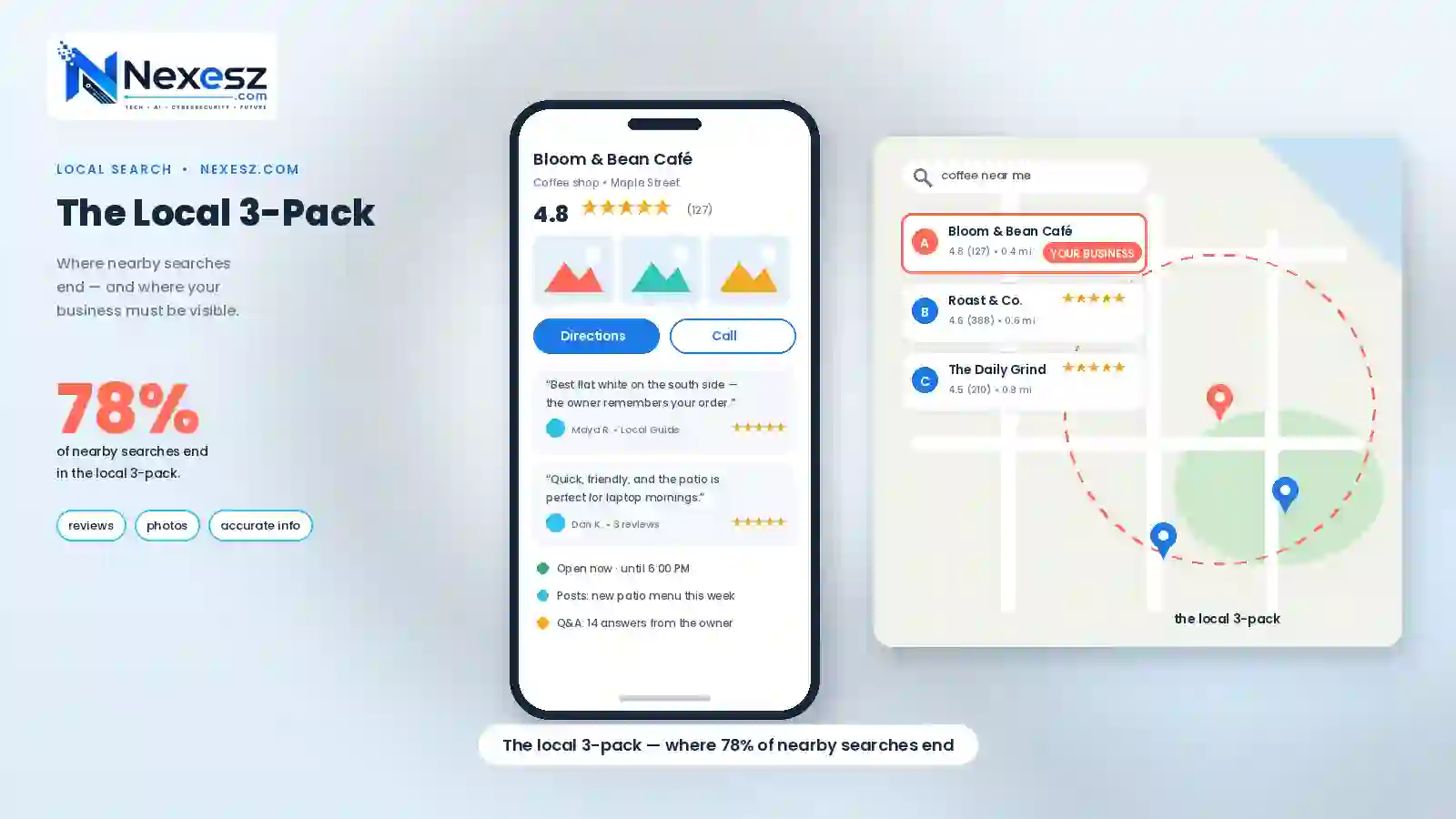
The local numbers are why I start every client here: 80% of U.S. consumers search for local businesses weekly, and 78% of location-based mobile searches end in an offline purchase.
The Google Business Profile is the most useful free tool in this guide: the average small business pulls 1,009 searches a month from it, and 42% of its conversions never touch the website. The checklist:
- Complete every field — complete profiles get 70% more location visits
- Add photos and enable messaging — messaging adds ~35% more leads
- Collect genuine reviews — top local positions average ~250 of them
- Keep name, address, and phone identical everywhere
Businesses doing local SEO for three straight years earn 2.7× the local organic traffic of first-year adopters
Step 3 — Create Content That Answers Real Questions
Content is the trust layer: it generates 3× the leads of outbound at 62% lower cost, averaging $7.65 per dollar (Revenue Memo, 2026).
The digital marketing ideas that work for small businesses aren’t elaborate. They’re consistent:
- How-to guides — for the exact problems your product or service solves
- Comparison posts — “X vs Y” and “X for [your niche]”
- Customer FAQs — the five questions every lead asks
- Case studies — before-and-after numbers, one page each
- Short videos — 21–34 seconds, repurposed across platforms
Video deserves its own line: short-form under 60 seconds is the #1 ROI content format for the fourth straight year (HubSpot, 2026), and 70% of small businesses already post it versus only 8% of large ones. That’s an advantage you won’t get back.
Write it the way high-quality content that ranks gets built: one question per page, real specifics, your own results.
Then use the AI already in your pocket: a stack of free AI tools for digital marketing handles research, first drafts, and repurposing — you supply the judgment.
Step 4 — Choose One or Two Social Platforms
Social is where your customers already talk — but 96% of small businesses use it now, so “having a page” is the baseline. What matters: 58% of consumers discover businesses through social (Revenue Memo, 2026).
Pick one or two platforms where your buyer already is:
- Facebook — local services, 35+ audiences
- Instagram — visual products, lifestyle, food
- LinkedIn — B2B and professional services
- TikTok — short-form reach, if you can make videos
Then post the same five things on loop: product in action, customer proof, educational tips, behind-the-scenes, a clear offer. Two to three posts a week, every week — that beats a viral hit followed by silence.
If the time isn’t there, hire it. The best social media marketing companies for small business separate on case studies in your industry, not follower counts — and a fixed monthly scope beats hourly billing.
Step 5 — Build an Email List That Compounds
Email is the highest-ROI channel in this guide — $36 to $42 back per dollar (Litmus, 2026) — and the only one you own. The retention math is why: repeat customers are 21% of e-commerce customers but 44% of revenue, and a 5% retention gain lifts profits 25–95% (Bain).
Use it for five jobs:
- Welcome new subscribers — welcome series open at 40–60%
- Announce new products or services first
- Follow up with leads who asked for a quote
- Win back customers who went quiet
- Share one useful tip a month
Automated flows beat manual campaigns — about 3× the clicks (Klaviyo, 2026) — so build the welcome, quote, and win-back flows before you send a broadcast.
Start the list with three motions: a signup box on the site, a one-line ask at checkout, and a follow-up within 24 hours of any lead.
One rule I follow: if a subscriber can’t tell in one read whether the email helped them, delete it. Lists grow when people stay.
Step 6 — Add Paid Ads With a Clear Offer
Paid ads are a speed tool, not a foundation — they work when you have a clear offer, a fast site, and a way to measure results.
Owners always want the list — the best platforms to advertise your business, in order of fit:
- Google Ads — captures people mid-search; ~$8 return per $1, start around $500–$1,000 a month
- Meta (Facebook/Instagram) Ads — retargeting and local radius targeting
- LinkedIn Ads — B2B only, and only if you sell to companies
- YouTube Ads — short, visual proof for consumer products
The real answer is one question: where does your customer search, and where do they scroll?
Start with $500 a month on one platform, run it 30 days, and read the numbers before the second. Winners don’t outspend competitors — they outmeasure them; every campaign tells you what it returned.
One 2026 curveball: visitors from AI search convert at 3.49%, above traditional organic. Show up where AI answers point, or your competitors will.
If you’re online-first, the e-commerce playbook covers the fundamentals that make the ad spend convert.
The Tactics That Work Best for Small Businesses
Here’s the whole plan — how to grow a small business using digital marketing in one repeatable stack:
- Niche your message — one customer, one promise, every channel
- Own the local results — Google Business Profile, reviews, local pages
- Publish weekly, including short video — content that answers real questions
- Stay on one or two platforms — consistency beats coverage
- Build the email list from day one — it’s the compounding asset
- Add paid ads only with a measurable offer — $500 tests, 30 days, read the data
Why this stack wins: small businesses running two or more channels together are 53% more likely to hit their email goals (Constant Contact), while 54% of small businesses are holding budgets flat in 2026 (LocaliQ). The ones that grow run the boring, repeatable version of this list every month.
When it outgrows the founder, there are two paths. Hire a specialist — searches for the best digital marketing agencies for small businesses 2026 surface plenty, and the ones worth paying for have local case studies and a fixed scope. Or, if you have the skills, start your own digital marketing agency and serve your own niche first.
Track Results and Improve Every Month
A channel you can’t measure is a channel you can’t improve. Two free tools cover 90% of what you need:
- Google Analytics — who visits, where they come from, what they do
- Google Search Console — which queries bring you in, which pages rank
Traffic trend, top queries, leads (calls, forms, bookings), cost per lead on any paid channel.
My monthly review runs 20 minutes around those four numbers, and it’s the quiet engine of how to grow a small business using digital marketing: 88% of small businesses that increased spend saw revenue improvement (Taradel) because they kept the numbers and doubled down on what worked. Every month, kill one thing that isn’t working and fund one thing that is.
The Bottom Line
The short answer to how to grow a small business using digital marketing is sequencing, not budget:
- Build the foundation first — fast site, complete profile, real reviews
- Let SEO and local search compound — the 61% that skip it are your open lane
- Publish weekly and stay on one or two platforms — consistency is the strategy
- Own the email list, then add paid with a measurable offer
The winners aren’t the ones with the biggest budget — they’re the ones running the same five moves every month.
Frequently Asked Questions
What is digital marketing for small business?
Digital marketing for small business means using online channels — SEO, social media, email, content, and paid ads — to reach customers, generate leads, and grow sales. Unlike traditional advertising, every channel is measurable — you can see which dollar came back as revenue.
Why should a small business invest in digital marketing?
Because the ROI stack is real and the barrier has dropped: email returns $36–$42 per dollar, local SEO about $13, Google Ads about $8 — and AI tools let a solo founder execute what a small agency used to do. 88% of small businesses that increased spend reported revenue growth.
What are the best digital marketing strategies for small businesses?
SEO and local search first — the 61% of small businesses that haven’t invested in it are leaving that channel open. Then weekly content, one or two social platforms, an email list from day one, and paid ads only with a measurable offer.
How can digital marketing help a small business grow?
By making every marketing dollar measurable: visibility through search, trust through content and reviews, repeat purchases through email, speed through paid ads — with a monthly review that doubles down on what returns. That’s how to grow a small business using digital marketing without an agency budget.
How long does digital marketing take to show results?
Local search and paid ads can produce leads within weeks — 42% of Google Business Profile conversions never touch a website — and email pays off from the first welcome sequence. SEO is the long game: 6 to 12 months to turn positive, but it compounds while you sleep.
Leave a Reply