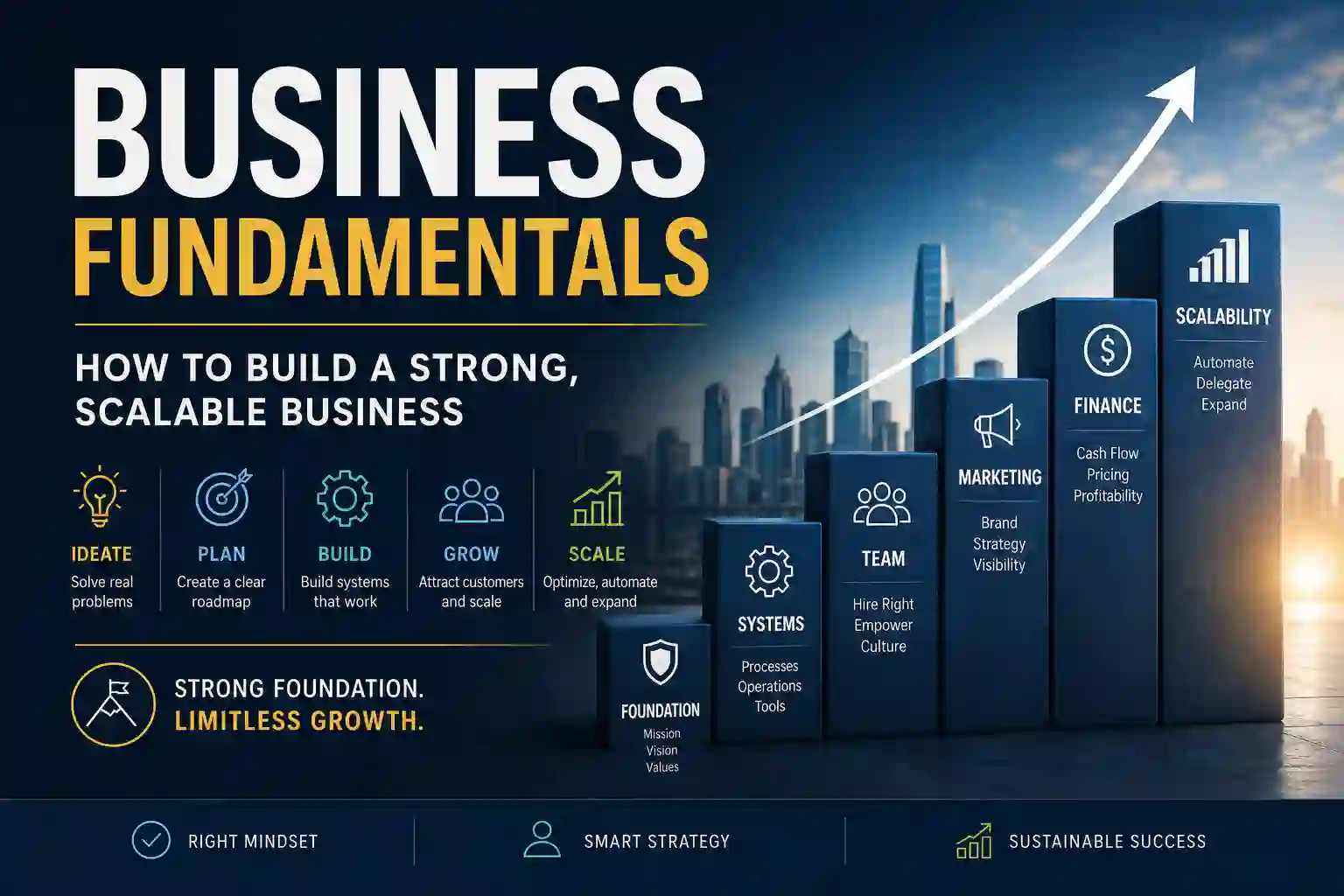
A successful business is rarely built on one idea alone. Strong companies usually begin with a clear understanding of their customers, a practical business model, a recognizable brand, and a strategy that can adapt as the market changes. These core elements form the foundation of long-term growth and help business owners make better decisions before investing too much time or money.
Understanding business fundamentals is especially important for small businesses, startups, and online entrepreneurs. When the foundation is weak, problems often appear later in pricing, marketing, customer acquisition, operations, and growth. When the foundation is clear, each part of the business can support the others.
This guide explains the core principles every entrepreneur should understand, from choosing a business model and researching a market to building a brand and creating a scalable strategy.
What Are Business Fundamentals?
Business fundamentals are the essential principles that help a company operate, create value, attract customers, manage resources, and grow sustainably.
These fundamentals include areas such as:
- Business model
- Market research
- Customer needs
- Branding
- Business strategy
- Pricing
- Marketing
- Operations
- Financial management
- Scalability
A business does not need to master everything on day one. The goal is to understand how these areas connect and build them gradually.
Why Business Fundamentals Matter
A good idea can fail when the business behind it lacks structure. For example, a company may have a useful product but struggle because it does not understand its target customer or has no clear way to generate consistent revenue.
Strong fundamentals help you:
- Make better decisions
- Understand your customers
- Reduce unnecessary spending
- Create a clearer value proposition
- Build repeatable processes
- Manage growth more effectively
For a broader view of how business, technology, marketing, and automation connect, see our Complete Guide to Building, Growing, and Automating a Modern Online Business.
What Are the Four Fundamentals of Business?
Many business concepts can be grouped into four major foundations: business model, market research, branding, and strategy.
Understanding these four areas gives entrepreneurs a practical framework for building a company.
1. Business Model
Your business model explains how the company creates value and makes money. It answers important questions such as who your customers are, what you sell, how you deliver it, and how revenue is generated.
A business might earn money through:
- Product sales
- Service fees
- Subscriptions
- Advertising
- Affiliate commissions
- Digital products
- Memberships
The business model needs to make sense for both the customer and the company.
2. Market Research
Market research helps you understand the people you want to serve. It can reveal customer needs, competitors, market demand, pricing expectations, and potential opportunities.
Without research, entrepreneurs may build products nobody needs or enter markets that are already difficult to compete in.
3. Branding
Branding gives your company a recognizable identity. It includes more than a logo. Your brand also involves your positioning, messaging, visual identity, customer experience, and reputation.
A strong brand helps customers understand what your business stands for and why they should choose it.
4. Business Strategy
Strategy connects your business goals with practical actions. It determines where you want to compete, which customers you want to target, what advantages you want to build, and how you plan to achieve your goals.
A strategy should be clear enough to guide decisions but flexible enough to change when market conditions change.
Choose the Right Business Model
Your business model affects almost every other decision you make. Before choosing one, think about what customers are willing to pay for and how you can deliver that value efficiently.
For example, a freelancer might use a service-based model, while a software company may use subscriptions. An ecommerce company may rely on product margins, while a creator might combine courses, memberships, and digital products.
When comparing the business model vs. business plan difference, remember that they are not the same thing. A business model explains how the business creates and earns value, while a business plan explains how you intend to build, operate, market, and grow the business.
A business can even change its model as it learns more about customers.
How to Choose the Right Business Model for an Online Business
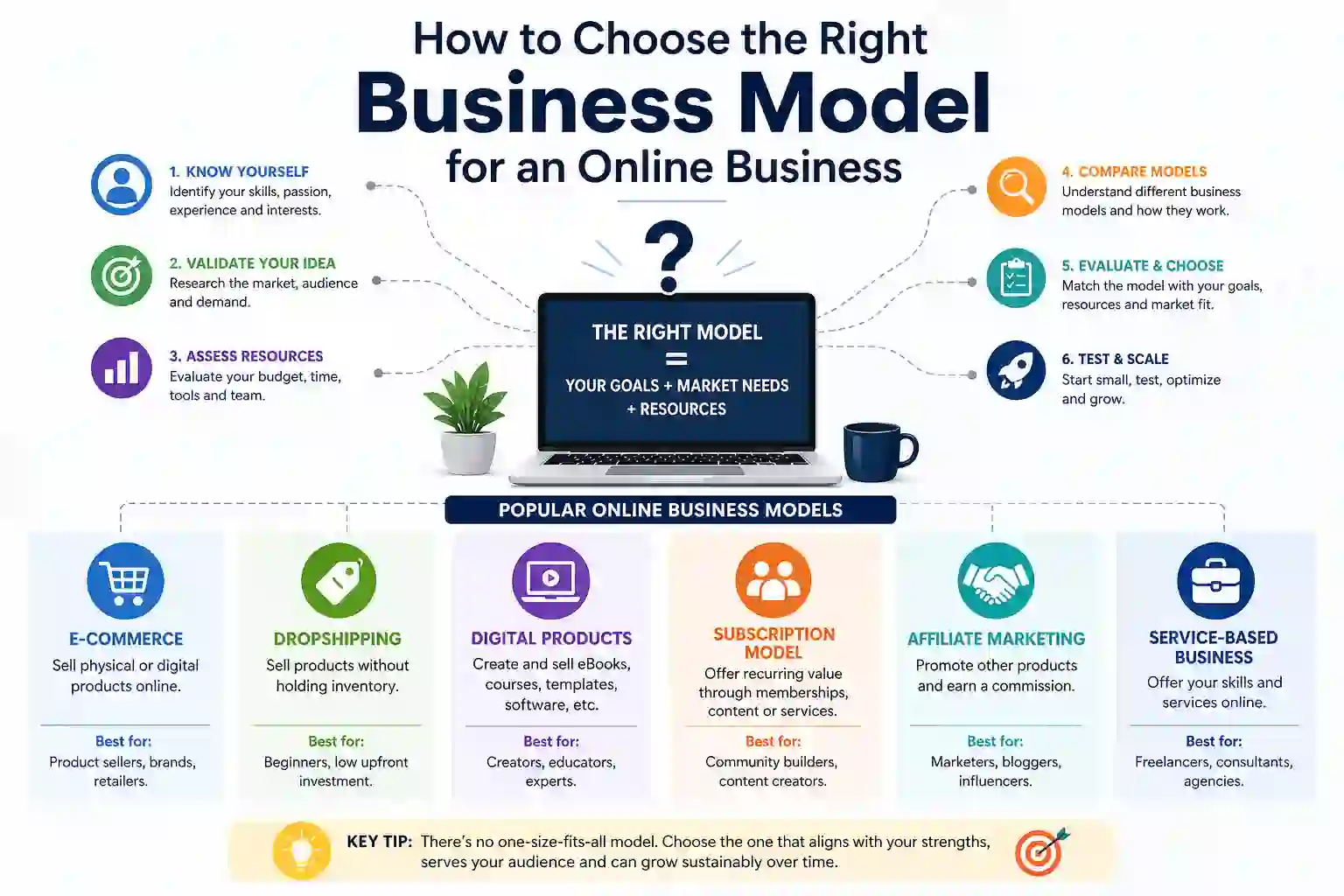
When deciding how to choose the right business model for an online business, start with the customer rather than the technology.
Ask:
- What problem am I solving?
- Who has this problem?
- How often do they need a solution?
- What are they willing to pay?
- How will I deliver the product or service?
- Can the model remain profitable as demand grows?
For example, a consultant may begin by selling one-to-one services. Later, the same expertise could be transformed into a course, template, membership, or software product.
The strongest online business models often become more efficient as systems improve.
How to Do Market Research for a Small Business Idea
Market research does not always require an expensive research firm. Small business owners can learn a lot by studying customers, competitors, search behavior, and existing products.
When considering how to do market research for a small business idea, start with these steps:
Identify the Target Customer
Define who is most likely to need your product or service. Consider their goals, problems, budget, location, and buying behavior.
Study Competitors
Look at similar businesses and examine their offers, pricing, positioning, reviews, and customer experience.
Analyze Customer Feedback
Reviews, forums, social media conversations, and support questions can reveal what people like and dislike about existing solutions.
Test Demand
Before investing heavily, test the idea with a small offer, a landing page, a survey, a prototype, or a limited launch.
This approach lets you learn before committing significant resources.
Build a Strong Brand
Once you understand the market, create a brand that communicates your value clearly.
Your brand should answer:
- Who are you?
- Who do you serve?
- What problem do you solve?
- Why should customers choose you?
- What makes your business different?
Consistency matters across your website, social media, products, customer service, and other touchpoints.
For example, if your brand promises simplicity, the buying process should also feel simple.
Branding vs Marketing: What’s the Difference?
The difference between branding and marketing for small businesses is easier to understand when you think in terms of identity versus promotion.
Branding defines how people perceive and remember your business. Marketing is how you attract attention, communicate your offer, and encourage people to take action.
Branding may include:
- Brand positioning
- Visual identity
- Messaging
- Tone of voice
- Customer experience
Marketing may include:
- SEO
- Content marketing
- Social media
- Email marketing
- Paid advertising
- Partnerships
They work best together. Strong marketing can bring people to your business, while strong branding can help them remember and trust it.
Build a Business Strategy That Can Scale
Once your model, market, and brand are clear, turn them into a practical strategy.
Your strategy should define:
- Business goals
- Target market
- Competitive advantage
- Revenue priorities
- Marketing channels
- Operations
- Growth targets
Keep the strategy measurable. Instead of saying “grow the business,” define a specific objective such as increasing qualified leads, improving retention, or reaching a particular revenue target.
Focus on Repeatable Systems
A scalable business depends on processes that can be repeated without constant manual effort.
Examples include:
- Standardized onboarding
- Content workflows
- Automated email sequences
- Customer support processes
- Sales pipelines
- Reporting systems
Systems reduce dependency on individual actions and make growth more manageable.
Financial Fundamentals Every Business Should Understand
Even strong products and marketing cannot compensate for poor financial management.
Business owners should understand:
- Revenue
- Gross margin
- Operating expenses
- Cash flow
- Customer acquisition cost
- Profitability
Revenue alone does not show whether a business is healthy. A company can increase sales while losing money if costs grow faster than revenue.
Track financial performance regularly and make decisions using realistic numbers rather than assumptions.
Create an Offer Customers Understand
A strong business foundation also requires a clear offer.
Your customer should quickly understand:
- What you sell
- Who it is for
- What problem it solves
- What result it provides
- Why it is worth the price
Avoid making your offer so broad that customers cannot tell what makes it useful.
For example, “We provide business services” is vague. “We help small online stores improve product-page conversions” is much more specific.
Connect Business Fundamentals With Marketing
Once the core foundation is clear, marketing becomes easier.
For a service-based business, this may mean combining SEO, content, social media, referrals, and email marketing. For an ecommerce company, it may involve search visibility, product content, paid advertising, email, and customer retention.
The important point is that marketing should support the business model rather than operate separately from it.
Build for Scalability From the Beginning
A scalable business does not simply sell more. It becomes capable of handling additional customers without costs and complexity increasing at the same rate.
You can improve scalability by:
- Automating repetitive tasks
- Documenting processes
- Using appropriate software
- Improving customer onboarding
- Outsourcing specialized work
- Building reusable content and systems
- Monitoring key performance metrics
Scalability should be planned gradually. Trying to build a complex organization before there is enough demand can waste resources.
Review and Improve Your Business Foundation
Business fundamentals are not something you study once and forget. As your customers, competitors, technology, and market change, your business may need to adapt.
Review your:
- Business model
- Customer needs
- Pricing
- Brand positioning
- Marketing channels
- Financial performance
- Operational systems
Regular reviews can help identify problems before they become expensive.
Conclusion
Strong businesses are built on more than a good idea. They need a workable business model, clear market understanding, consistent branding, sound strategy, healthy finances, and systems that support growth.
Understanding business fundamentals gives entrepreneurs a practical foundation for making better decisions. Start by understanding your customer, choose a model that can create sustainable value, research the market before investing heavily, and build a brand that clearly communicates what your business offers. Then connect these elements through a measurable strategy and improve them as your company grows.
For entrepreneurs building an online business, these foundations become even more important because technology, marketing, automation, and customer experience are closely connected. A strong foundation makes it easier to grow without losing focus or control.
Frequently Asked Questions (FAQs)
1. What are the main business fundamentals?
The main foundations include the business model, market research, branding, strategy, financial management, marketing, and operations.
2. Why are business fundamentals important for beginners?
They help beginners understand customers, avoid poor decisions, manage resources, and create a stronger foundation before investing heavily in growth.
3. What is the difference between a business model and a business plan?
A business model explains how a company creates and earns value, while a business plan explains how the company intends to operate, market, and grow.
4. How can I choose a business model?
Start by understanding your target customer, the problem you solve, how you will deliver the solution, what customers will pay, and whether the model can remain profitable as the business grows.
5. Can business fundamentals change over time?
Yes. Customer needs, competition, technology, pricing, and market conditions can change, so businesses should regularly review and improve their core foundations.
Leave a Reply