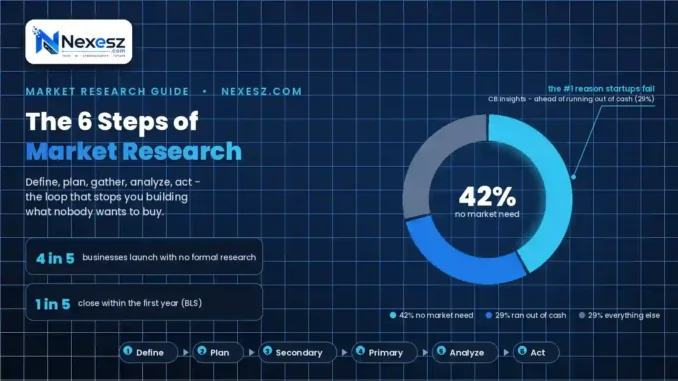
42% of small businesses fail because nobody wanted what they were selling. CB Insights lands on that number again and again. The business was not badly built, underfunded, or poorly run. The market simply was not there. What makes it worse is that roughly four out of five businesses launch without any formal research at all. They skip the steps of market research, guess at their customer, and hope. This article walks through how the process works, what it costs, and how to run a full round on almost no money. If the bigger picture is fuzzy, start with what a business model is so the terms below have somewhere to land.
What Are the Steps of Marketing Research?
Market research is the habit of gathering and checking information about your customers, your competitors, and your industry before you commit money to a decision. Marketing research is the same idea pointed at your marketing choices, and for a small owner the two collapse into one activity. The steps have not changed in decades. Define what you need to learn, plan how, gather the information, look for patterns, act on what you find. Every framework you meet, from a one-page checklist to a university course, is a variation on that loop.
Why Most Owners Skip It
The honest answer is fear and speed. Research feels like an extra cost before the business has earned a dollar. The numbers argue the opposite. CB Insights puts no market need at 42% of startup failures, ahead of running out of cash at 29%. The Bureau of Labor Statistics says roughly a fifth of new businesses close within the first year, and half are gone by year five. A product that solves a real problem for a reachable group of buyers also tends to fit one of the proven types of business models, which is worth understanding before you settle on your revenue source.
Stages in Market Research
Strip the jargon away and every study fits into three stages that map onto your calendar.
- Define. Write down the decision you are trying to make and the question that must be answered before you can make it. This stage is a page of notes, not a project.
- Gather. Collect what already exists, then collect what only your customers can tell you. This stage takes most of the time.
- Analyze. Put the information in one place, look for patterns, compare it against your assumptions, and decide.
The academic term for the whole loop is marketing research. You are not trying to publish. You are trying to stop guessing.
6 Steps of Market Research
[Image 2 yahan lagani hai — is heading ke turant baad]
Here is the full version, the one a solo owner can actually finish.
What Is the First Step in the Marketing Research Process?
Every framework agrees on step one, and it is not data. It is defining the problem. Beginners usually start with a symptom: my sales are down, or my competitors are cheaper, and collect information that answers the symptom instead of the cause. The fix is to drill down until you can write the decision in one sentence. Should I raise my price from $50 to $75? is a decision. How do I do marketing better? Is a mood. From that sentence, write two measurable objectives. For the pricing example, do my best customers still see value at $75, and does the raise pay back in two months? Get this step wrong, and the rest of the process only gets faster at the wrong answer.
Step Two — Develop the Research Plan
Now you decide how you will answer your objectives. Four parts.
- Qualitative or quantitative. Open answers versus numbers, and most small owners need a little of both.
- Primary or secondary. Information from your own conversations versus information already collected. The default order is secondary first.
- A budget. For most owners, that means time rather than money.
- A deadline. Open-ended research never ends on its own.
Two question clusters deserve explicit room. Product questions cover the problem you solve, what people will pay, and which features matter. Marketing questions cover message, channels, and how buyers see the competition.
Step Three — Gather Secondary Data First
Secondary data is everything that already exists, and it is free.
- Government data. The Census Bureau, the Bureau of Labor Statistics, and the Small Business Administration publish demographics, industry counts, and spending figures.
- Industry reports and trade publications. They summarize trends for you.
- Competitor websites, pricing pages, and reviews. They show what the market already accepts and where providers fall short.
- Google Trends. It shows whether interest in your category is rising or fading.
Start here because it sharpens the primary questions. If you are sizing the market, count your realistic customers and multiply by what they spend per year. That bottom-up number beats a sliced-down industry figure.
Step Four — Collect Primary Data
Primary data is what you collect yourself from real people.
- Interviews. Five to ten conversations of twenty to thirty minutes each reveal why people do or do not buy.
- Surveys. Fifty to a hundred responses, free in Google Forms, reveal what is common enough to plan around.
- The checklist. One open-source list that founders keep on GitHub covers both sides. For rivals, copy down the one-liner, pricing, model, and social presence. For customers, find contacts who could become buyers, attend one meetup, and reach out to a few of your competitors’ customers.
Two rules protect the quality. Ask neutral, open questions rather than leading ones, and never run the study on your family and closest friends, who will protect your feelings instead of your numbers. Questions worth asking include what you struggle with day to day, what almost stopped you from buying, and at what price would this feel too expensive. Those come from the classic four-question price sensitivity set, which also asks for a bargain price and a so-cheap-you-doubt-the-quality price. In two or three minutes in any survey, it maps your acceptable price range.
Step Five — Analyze the Data
Analysis for a small business happens in a spreadsheet, not a statistics degree.
- Count what repeats. Put the survey answers in rows and let the tallies do the arguing.
- Read the unprompted phrases. The words people use in interviews are usually the insight.
- Respect the sample size. A hundred responses gives roughly a ten-point margin of error, enough for direction, not for small segments.
- Compare against the secondary data. If both point the same way, you have a finding. If they disagree, that disagreement is usually the most valuable thing in the file.
- Let AI do the first pass. Most owners now hand transcripts and open answers to a language model for summarizing and coding. 82% of small businesses run at least one AI tool in daily work.
Step Six — Turn Findings Into Action
Research that sits in a spreadsheet changes nothing, so the final step writes the output.
- The decision. One sentence, the same one you started with.
- The three findings that support it.
- The change, and by when.
- The recheck, ninety days out.
Owners skip this step more than any other, and it is the step that separates a business that learns from one that collects.
5 Steps of the Marketing Research Process
If you have searched for steps in the marketing research process, you have probably noticed the lists disagree. Textbooks run seven steps because they split planning into design, sampling, and forms. Practical guides compress it to four. The five-step version, the one most working owners use, looks like this.
- Define the problem and write the decision.
- Build the plan in one pass, method and budget together.
- Collect the data, secondary first, then primary.
- Analyze and report. One page is enough.
- Act on a date.
Whether a guide lists five or seven of the steps of market research, the first and last never change. Definition and action decide outcomes, and the middle is plumbing. Use the six-step version when starting something new; the five-step version fits when you already have customers and need to test one move.
Market Research Process Steps in the Real World

The steps of market research look different depending on what you sell. Here is what the same loop does in three real shops.
- The food truck owner wants to know if the lunch crowd will pay $14 for a specialty wrap. Secondary data first: city permit figures, foot-traffic estimates, what the three existing trucks charge. Then primary: ten minutes of chat with office workers at noon, plus a one-question poll on a community page. The decision, a four-day pilot menu, costs almost nothing.
- The SaaS founder is choosing between $29 and $49 per month. They mine sign-up data and support tickets, read the pricing pages and reviews of five close competitors, then send a five-question survey to the 120 people who used a free trial. This is where a solid saas business model meets the evidence.
- The freelance designer wants to justify moving from hourly rates to a monthly retainer. She interviews four of her happiest clients about what a month of work looks like, checks how two competing studios price their service, and finds that everyone she already knows thinks in monthly terms. The retainer follows the same subscription-business-model logic the bigger studios use, only smaller.
The famous versions scale up nicely. Instagram began as Burbn, a check-in app whose users mostly just shared photos, so the company became a photo app. Slack began as the chat feature of a video game nobody played, and became the messaging platform Salesforce bought for $27.7 billion. And Juicero spent years building a $120 juice press while skipping the question its customers would have answered in an afternoon. They already squeezed the same juice with a $20 bag cutter.
A One-Week, Zero-Budget Research Plan
Running the steps of market research in one week sounds cramped, but the loop fits in seven days if you keep each day narrow. Every item below is free.
- Day one. Write the decision and the one-sentence problem, plus two measurable objectives.
- Day two. Competitor teardown, five rivals, one-liner, pricing, model, social presence, and their worst reviews.
- Day three. Secondary sweep, government data, industry reports, Google Trends, and your own numbers.
- Day four. Five customer conversations of twenty minutes each, booked the day before.
- Day five. Send the survey, ten questions maximum, to everyone you can reach.
- Day six. One spreadsheet, count what repeats, read the notes for unprompted phrases.
- Day seven. The one-page output, the decision, three findings, the change, and the ninety-day recheck.
Whatever the week produces, mapping the answer onto a business model canvas before you commit keeps idea, customer, and money line honest, and turns notes into a defensible plan.
Conclusion
The steps of market research are the least glamorous part of building a business and the cheapest insurance it has. You need a decision in one sentence, a week of disciplined attention, and the willingness to be wrong on paper instead of in the bank account. Start with the problem, gather what is free, ask a handful of real customers, and write the answer down. Do that once a year, and more often before major changes, and you will have built what most competitors never have: a business that knows its market instead of hoping in it. The other foundations a business runs on, from pricing to cash flow, live in business fundamentals, and they work on top of that knowledge, not instead of it.
Frequently Asked Questions
What is market research in simple terms?
It is checking your assumptions against reality before you spend the money. You find out who would buy, what they would pay, and what they use today, using data that already exists plus a few direct conversations.
How long does market research take?
A first serious round takes about a week of part-time work. Secondary research is a couple of days, five to ten interviews are a few afternoons, and a survey fills itself in a few days. The ongoing version, scanning reviews and competitors, is an hour a month.
How much does market research cost?
Often nothing. Government data, Google Trends, review sections, and Google Forms are free, and the only real expense is your time. Paid panels and agencies start at a few hundred dollars and are worth it only for large decisions.
What is the best method for a small business?
A small survey plus a handful of interviews, and the order matters. Start with secondary data so you know the shape of the market, then let five to ten conversations do the work no report can. If you remember one thing about the steps of market research, let it be this. The method is cheap, and the assumption is expensive.
Do I need to repeat market research after launch?
Yes, but lighter. The full round happens at launch, before a price change, and before a new market. After that, the habit is a recheck every six to twelve months plus a monthly scan of reviews and competitor pricing. Markets shift and preferences drift, and the owner who rechecks keeps the plan honest
Leave a Reply