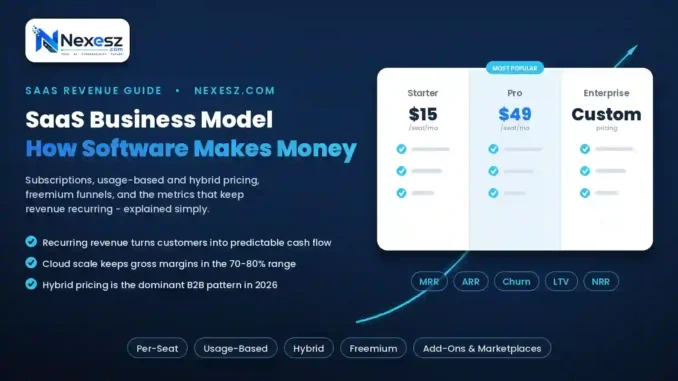
Software used to be a one-time purchase: a box, a license key, and a support phone number. Today, the tools people depend on every day — Slack, Notion, Zoom, Salesforce — are delivered through the cloud and paid for as access, not ownership. The SaaS business model has become the default way to build a software company because it turns customers into recurring revenue and a product into a compounding asset. This article explains how the model works, the revenue streams behind it, and the practical choices founders make when deciding how their product earns. If you are new to the topic, it helps to start with what a business model is before zooming into one specific type.
What Is a SaaS Business Model?
Under this model, software is delivered over the internet on a subscription basis. Customers pay a recurring fee — usually monthly or annually — instead of buying a perpetual license, and the provider hosts, maintains, and continuously updates the product.
In 2026, the global SaaS market is projected to reach roughly $512 billion, growing at about 14.7% per year toward $887 billion by 2030, according to Statista. The scale exists for a reason: subscription software lowers the cost of entry for buyers, gives vendors predictable income, and lets both sides skip the upgrade cycles that made old licensing painful.
It is one of the most established types of business models in the digital economy. The SaaS business model works the same way whether the product is a CRM, a design tool, or an AI platform: build once, host centrally, and bill continuously.
How SaaS Works in Simple Terms
Three ideas define the setup. First, the vendor owns the infrastructure: servers, security, and updates all happen on the provider’s side. Second, access is rented, not owned — a subscription grants usage rights for a billing period. Third, the product evolves in place. A new feature or an AI assistant can reach every customer the same day without an install, which is why modern platforms ship changes continuously instead of once a year.
SaaS vs Traditional Software Licensing
| Dimension | Traditional licensing | SaaS |
|---|---|---|
| Payment | One-time purchase plus maintenance | Recurring monthly or annual subscription |
| Hosting | Customer’s own servers | Provider’s cloud |
| Updates | Manual, periodic | Continuous, automatic |
| Scaling | Buy more licenses and hardware | Add users instantly |
| Time to value | Weeks of installation | Minutes to first login |
Most software has moved to the right column. Perpetual licenses still exist in niche, heavily regulated environments, but the direction of the market is clear.
SaaS Business Model Characteristics
Four traits separate this model from most other ways of selling software.
Recurring Revenue and Predictable Cash Flow
Revenue arrives on a schedule, and that predictability changes everything. Founders can forecast cash, investors value the company as a multiple of annual revenue, and product teams plan a year ahead instead of chasing the next big sale.
Scalability With Low Marginal Cost
Serving the ten-thousandth customer costs a fraction of serving the first. Cloud hosting spreads fixed costs across every subscriber, which is why many SaaS companies run gross margins in the 70–80% range. The trade-off: growth must stay ahead of churn, or the base quietly leaks.
Cloud Hosting, Continuous Updates, and Data-Driven Iteration
Because every customer runs the same live product, teams can measure real usage, test features, and fix problems for everyone at once. Usage data becomes a compass: it shows which features drive retention and which pricing changes lift conversion.
The Metrics That Matter: MRR, ARR, Churn, and LTV
- MRR / ARR — recurring income normalized to a month or a year; the base every other metric hangs on.
- Churn — the share of customers or revenue lost each period; the quiet killer of subscription businesses.
- CAC — the cost to win one customer; it has to stay below the revenue that customer generates.
- LTV — the total revenue a customer is expected to deliver; LTV relative to CAC is the classic health check.
How SaaS Companies Make Money: Core Revenue Models
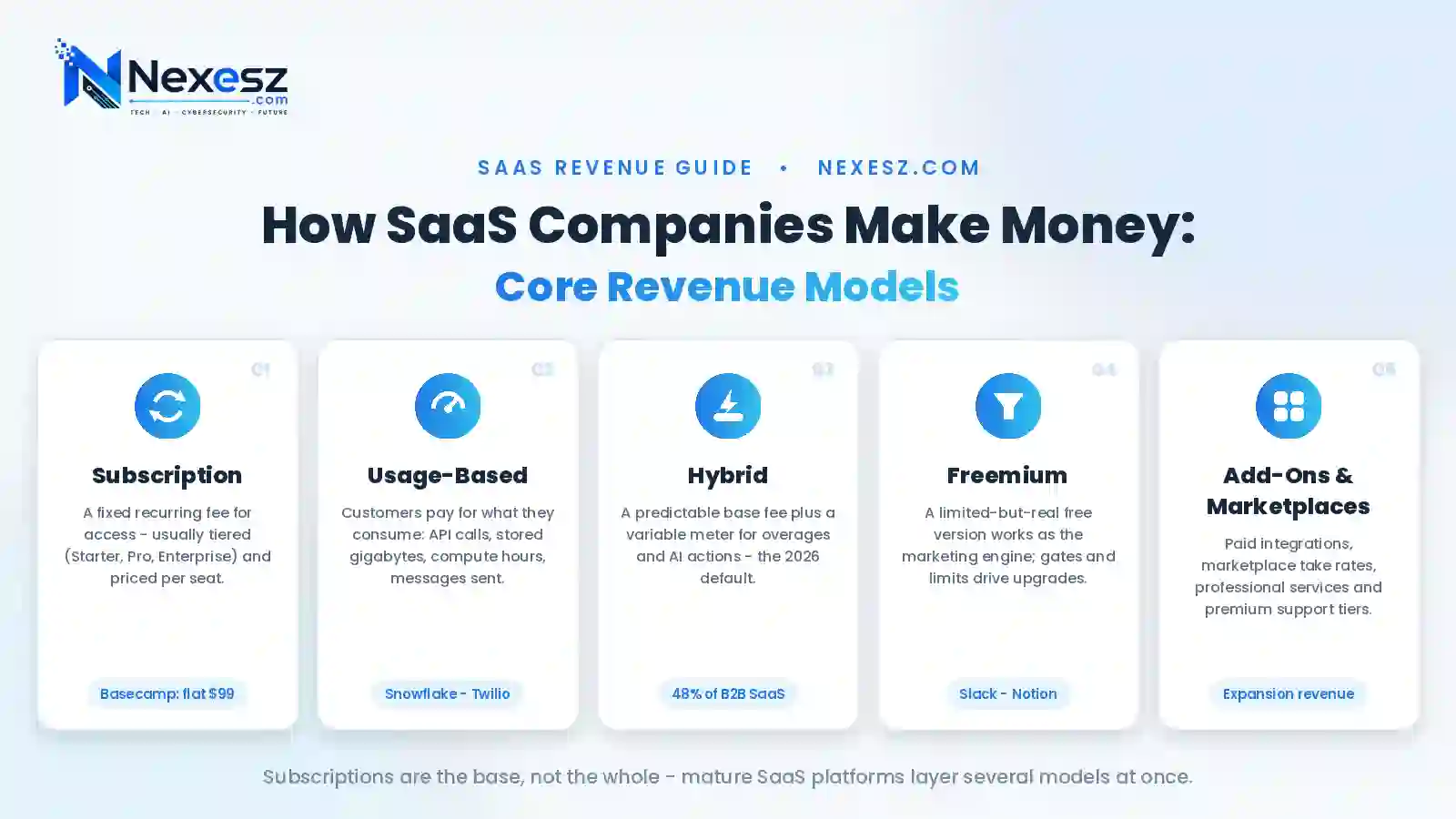
Revenue design is where the SaaS business model gets strategic. A handful of SaaS revenue models dominate the market, and each fits a different kind of product.
Subscription Pricing: Per-Seat, Tiered, and Flat
The classic engine. Customers pay a fixed fee for access, usually organized in tiers (Starter, Pro, Enterprise) and often priced per seat. Seat-based plans fit collaborative tools where every team member adds value; flat plans — like Basecamp’s single $99 price — trade expansion revenue for simplicity and a memorable position in the market.
Usage-Based Pricing
Customers pay for what they consume: API calls, stored gigabytes, compute hours, messages sent. Snowflake and Twilio built their scale this way. Usage-based billing lowers the barrier to try — a customer can start at almost zero — and captures more from heavy users, but invoices become less predictable, which some buyers resist.
Hybrid Models: The 2026 Dominant Trend
A predictable base fee plus a variable meter. The base subscription covers platform access; overages, AI actions, or extra volume bill on top. Hybrid has become the dominant B2B pattern: ICONIQ’s 2026 Go-to-Market report found 48% of B2B SaaS companies run it as their primary model, and Chargebee projects 61% of SaaS companies using some hybrid form by the end of 2026. AI made the shift urgent — agents burn compute, so charging only by seat underprices the product.
Freemium and Free Tiers
A limited-but-real free version acts as the marketing engine. Slack capped message history at 10,000 messages; Canva gates premium templates; Notion is free for individuals and paid for teams. Free users become the funnel — the goal is a genuine aha moment, followed by a usage limit, feature gate, or team need that makes upgrading feel obvious.
Beyond Subscriptions: Add-Ons, Marketplaces, and Services
Subscriptions are the base, not the whole. Mature platforms layer on paid add-ons and integrations, marketplaces where third parties sell with a take rate for the host, professional services for implementation, and premium support tiers. A few consumer-leaning products also run advertising, but ads remain rare in B2B, where trust is the product.
How SaaS Companies Monetize Through Payments and Billing
A common question is how can SaaS companies make money from payments. The short answer: payments are the machinery that converts recurring commitments into actual cash flow, and the quality of that machinery decides how much revenue survives. The SaaS business model runs on subscriptions, but subscriptions only exist on paper until a card is charged, an invoice is paid, or a bank transfer lands.
Recurring Billing Infrastructure
Platforms like Stripe Billing or Recurly handle the mechanics: creating subscriptions, prorating plan changes, invoicing, processing card and bank payments, and retrying failed charges. For a startup, billing works on day one without building payment plumbing from scratch.
Payment Methods, Dunning, and Renewal Optimization
Failed invoices are a silent revenue leak. Dunning — the sequence of retries, email reminders, and payment-method updates after a failed charge — can recover a large share of what would otherwise be lost. Annual plans, local payment methods, and direct-debit options further cut friction at renewal, which is where subscription revenue is won or lost.
How Billing Drives Expansion Revenue
Billing is also a growth tool. When a customer adds seats, upgrades a tier, or crosses a usage threshold, the next invoice rises automatically — expansion revenue without a new sale. Companies that track net revenue retention measure exactly this: whether existing accounts grow over time.
B2B SaaS: How Enterprises Buy and Why Retention Decides
The B2B SaaS business model differs from consumer SaaS in two structural ways: longer buying cycles and higher stakes per account.
Self-Serve vs Sales-Led Selling
Small teams often buy themselves: sign up, trial, pay with a card — a motion powered by free tiers and fast onboarding. Enterprise deals invert the motion: procurement, security review, negotiation, annual contracts, and sometimes custom pricing. Mature companies usually run both, letting self-serve logos grow until an account outgrows the automated motion.
Per-Seat Pressure and the Shift to Hybrid Pricing
AI is rewriting an old assumption. When agents complete work that used to require a paid human seat, customers buy fewer seats without buying less value. IDC projects that 70% of software vendors will move away from pure per-seat pricing by 2028, and Gartner expects 40% of enterprise applications to embed task-specific agents by the end of 2026. Hybrid pricing — a seat base plus a meter for AI usage — is how most companies are repositioning.
Net Revenue Retention as the New Valuation Signal
Retention is the variable that decides whether the SaaS business model economics work. Net revenue retention above 100% means existing customers expand faster than they leave, and investors now price companies on it more than on raw ARR growth. A B2B company that keeps and grows its base funds expansion without constantly buying new logos.
Real-World Examples: How Leading SaaS Companies Earn
SaaS business model examples make the patterns concrete.
Slack, Notion, and HubSpot: Freemium Growth Engines
Slack gave teams unlimited users but capped message history at 10,000 messages — an active team hit that wall within weeks and upgraded. Notion let individuals use it for free while teams paid, spreading product by product inside companies. HubSpot’s free CRM works as a lead engine for its paid marketing, sales, and service suites. In each case, the free tier is not a discount; it is the acquisition channel.
Snowflake and Twilio: Usage-Based at Scale
Snowflake bills storage and compute separately, so a customer’s cost tracks the work the data warehouse actually does. Twilio charges per message, call, and verification sent. Both let small users start nearly free and heavy users pay what the value justifies — with the predictable downside that a few large accounts can concentrate revenue risk.
Intercom: Outcome-Based Pricing in the AI Era
Intercom’s AI agent Fin charges $0.99 per resolved conversation. The customer pays for results, not seats or minutes — a structure that aligns price with value but requires clean measurement of what counts as a resolution. Outcome-based pricing is the frontier: highest alignment, highest measurement burden.
Why the SaaS Model Keeps Winning: Key Benefits
The benefits of SaaS business model adoption explain why it keeps winning:
- Predictable cash flow — recurring subscriptions make forecasting possible and financing easier.
- Low cost to serve growth — cloud hosting keeps marginal costs near zero, with gross margins commonly in the 70–80% range.
- Lower barrier for customers — no upfront license cost, no installation, first value in minutes.
- Continuous improvement — every customer receives updates and new features automatically.
- Compounding data advantage — usage data sharpens product decisions, retention, and pricing over time.
How to Choose the Right SaaS Monetization Strategy
Match Pricing to How Customers Experience Value
Start from the customer’s side, not the spreadsheet. A tool whose value scales with headcount suits per-seat pricing. A product whose cost and value scale with volume — APIs, AI, communications — is well-suited to usage-based billing. A platform with multiple personas and segments usually needs a hybrid: a predictable base plus a meter for what varies.
Pricing Tiers to Consider at Launch
Most early products work with three tiers: a low-entry plan that removes friction, a mid-tier that drives most of the revenue, and an enterprise tier with security, limits, and support that justify custom pricing. Keep the math simple at first — pricing pages with three plans convert better than pages with eleven, and billing complexity is engineering cost you pay forever.
Conclusion
In short, the SaaS business model turns software into a recurring relationship instead of a one-time sale. Subscriptions provide the predictable base, usage and hybrid meters capture variable value, freemium feeds the funnel, and billing infrastructure protects the revenue that arrives. The pattern is consistent across serious players: match pricing to how customers experience value, then protect retention — because in subscription software, keeping customers is the entire game.
Frequently Asked Questions
How do SaaS companies make money?
Most earn through recurring subscriptions billed monthly or annually. Usage-based fees, hybrid plans, freemium upgrades, and add-ons expand that base over time.
What is the difference between SaaS and traditional software?
Traditional software is bought once, installed on-premises, and updated manually. SaaS is hosted in the cloud, billed as a subscription, and updated continuously by the provider.
Is the SaaS model profitable for small startups?
It can be, when costs stay below recurring revenue. Cloud hosting is cheap to start, but churn, acquisition costs, and support quality decide whether margins hold.
What is churn, and why does it matter?
Churn is the share of customers who cancel within a period. It leaks recurring revenue, so retention work directly protects the predictable income that defines the model.
How do I choose between subscription and usage-based pricing?
Match the model to how value is experienced. Team tools where every user adds value fit per-seat subscriptions; variable-cost products like APIs and AI workloads fit usage-based billing.
Leave a Reply