Every company you’ve ever bought from runs on one of a handful of proven patterns for making money. Understanding the types of business models available helps you pick one that actually fits your product, your customers, and how much control you want over delivery.
This guide breaks down 14 of the most common models, with a real brand example for each, plus how they connect to ecommerce specifically and how a business model differs from a full business plan.
None of these models are mutually exclusive, and plenty of businesses on this list combine two or three of them at once. The goal here isn’t to pick a rigid label, but to understand which existing pattern your idea most closely resembles.
What Is a Business Model?
A business model is simply a representation of how a company makes, or intends to make, money. Alex Osterwalder, who created the widely used Business Model Canvas, frames it this way: a simplified picture of how a business operates, without getting lost in every process and workflow detail.
At its core, a model answers who you serve, what value you provide, how you deliver it, and how revenue flows back to the company.
Osterwalder’s framework breaks this down further into nine specific building blocks: customer segments, value proposition, channels, customer relationships, revenue streams, key resources, key activities, key partners, and cost structure. Most founders don’t need to map all nine formally, but thinking through each one catches gaps a simpler explanation might miss.
Before exploring the 14 specific categories below, it’s worth noting that this canvas framework applies to any of them — a subscription business and a wholesale business both fill in these same nine blocks, just with very different answers.
What Similar Terms Actually Mean
People often search for a business model synonym when what they actually mean is one of several related but distinct concepts.
“Business design,” “value creation,” and “revenue approach” all get used loosely as stand-ins, but none is a perfect synonym. A revenue model, for example, describes only how money is collected — it’s one piece of the full business model, not the whole thing.
The clearest way to think about it: a business model includes your customers, your value proposition, your resources, and your costs, while a revenue model narrows in on just the money-collection mechanism inside that larger picture.
Model vs. Plan: How These Two Terms Differ
These two get confused constantly, and mixing them up leads to wasted planning effort.
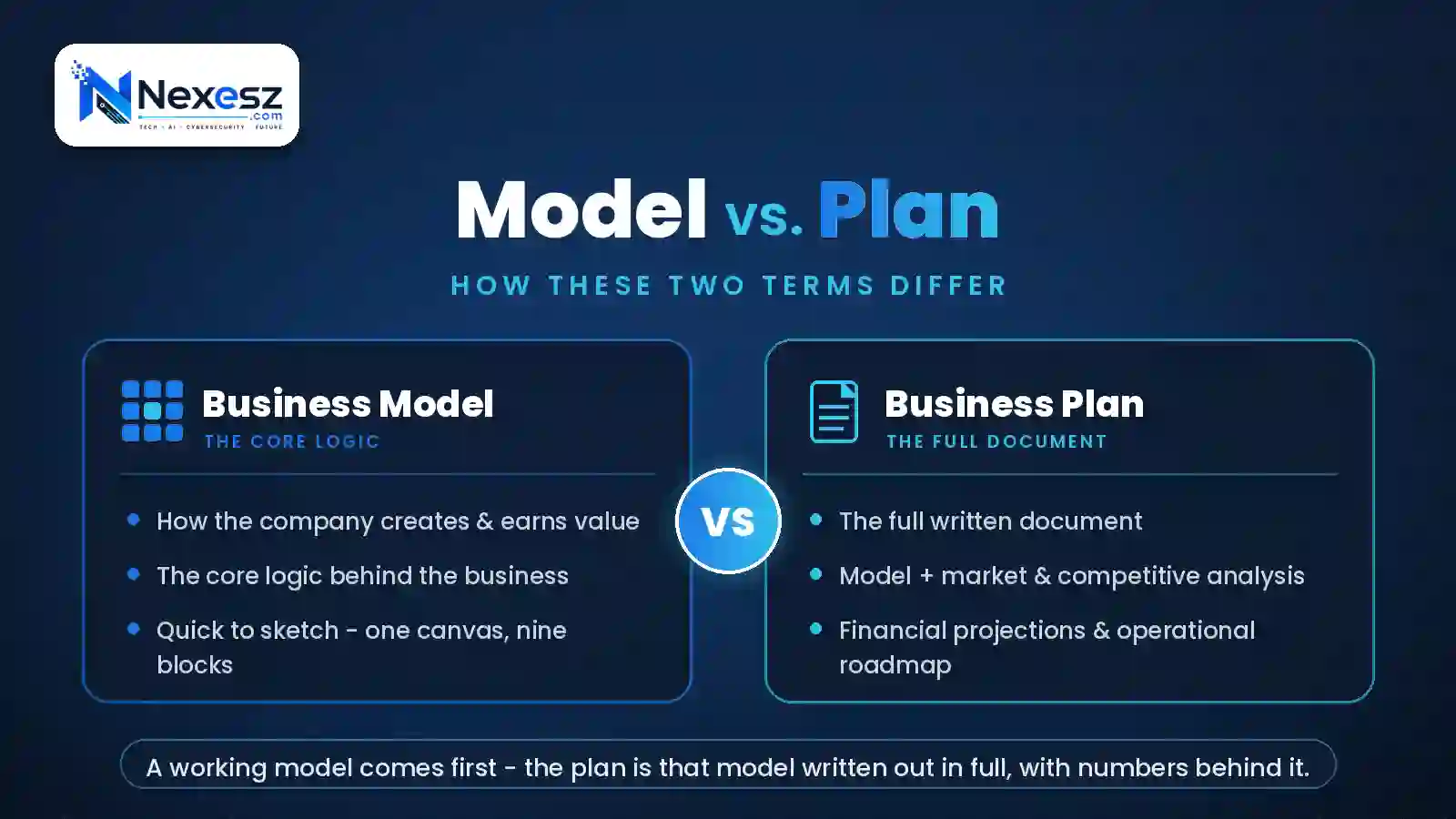
The business model and business plan difference comes down to scope. A business model explains how the company creates and earns value — it’s the core logic. A business plan is the full document: that model plus market research, competitive analysis, financial projections, and an operational roadmap.
You generally need a working model before a business plan means anything, since the plan is essentially the model written out in full detail with numbers behind it.
The 14 Types of Business Models
Most companies fall into one of these established patterns, though plenty combine more than one. Spotting the different types of business model at play in a company you already know is often the fastest way to understand your own idea.
1. Retail
A retail business sells products sourced from wholesalers, manufacturers, or private-label suppliers, either in stores, online, or both. Most retail transactions happen directly with individual shoppers.
Luxury floral brand Venus et Fleur started online in 2015 and later expanded into physical stores, managing both online and in-person retail channels as it grew.
Retail works best when a business can source products reliably and differentiate on curation, service, or convenience, since customers can often find similar items at multiple retailers.
2. Wholesale
Wholesalers sell products in volume to retailers or other businesses rather than to individual end customers. This model avoids product development costs but requires purchasing inventory upfront.
Coffee brand BLK & Bold sells wholesale to cafés, offices, and hospitality venues alongside its own direct-to-consumer sales, splitting revenue across both channels.
The tradeoff with wholesale is margin: retailers and cafés buying in bulk expect a lower per-unit price than an individual customer would pay directly, but the volume can make up for the thinner margin.
3. Manufacturing
A manufacturing business controls how its product is actually made, either in-house or through a contract manufacturer, using private-label, white-label, or handmade production.
Old World Kitchen, a handcrafted kitchen utensil brand, moved from selling on Etsy to its own store specifically to gain full control over pricing, branding, and production quality.
This model demands more upfront capital than most others on this list, since samples, tooling, and minimum order quantities all need funding before the first sale ever happens.
4. Dropshipping
In dropshipping, the merchant lists and sells products without holding any inventory. A supplier stores the goods and ships each order directly to the customer once it’s placed.
Subtle Asian Treats built a dropshipping business around plushies and phone accessories, growing through social media and user-generated content rather than paid ads alone.
Margins tend to be thinner here since the supplier’s fees eat into each sale, but the near-zero upfront inventory cost makes it one of the most accessible models for testing a product idea quickly.
5. Print-on-Demand
Print-on-demand businesses sell products that are only produced after a customer orders them, with a supplier handling printing and shipping. No finished inventory sits waiting to sell.
Fanjoy runs a print-on-demand marketplace connecting independent creators with fans, and has shipped more than three million packages using this exact model.
Because production only happens after a sale, founders can test many designs quickly without ever risking money on unsold inventory sitting in a warehouse.
6. Direct-to-Consumer (DTC)
A DTC brand sells straight to its end customers, skipping traditional retailers entirely. This means keeping the full retail margin, but also covering all marketing and fulfillment costs directly.
Italian footwear brand Velasca launched as a DTC shoe company connecting customers straight to shoemakers, and now sells across more than 30 countries through its own site.
Going direct means keeping customer data and the full retail margin, but it also means the brand alone is responsible for driving traffic and building trust without a retailer’s existing customer base.
7. Subscription
A subscription model charges a recurring fee, usually monthly or annually, for ongoing access to a product or service rather than a single payment.
Netflix built one of the most recognizable subscription businesses in the world, charging a flat monthly fee for unlimited streaming instead of billing per title watched.
The appeal is predictable, recurring revenue instead of chasing a brand-new customer for every sale — though retention becomes just as critical as acquisition, since a subscriber can cancel at any time.
8. Digital Products
Digital products are delivered electronically with no physical inventory involved. Once the product exists, each additional sale costs very little to fulfill.
Pixie Faire sells downloadable sewing patterns for doll clothes, turning that digital-delivery model into a business reportedly generating around $50,000 per month.
Since there’s no shipping or manufacturing cost per unit, digital products can carry unusually high margins — the main risk is unauthorized copying or free alternatives undercutting willingness to pay.
9. Service-Based
Service-based businesses sell time, labor, or expertise rather than a physical or digital product, charging either hourly rates or fixed project fees.
Photo-editing company Path built its service business around a flat per-photo fee structure rather than hourly billing, scaling through a team of hundreds of editors.
The tradeoff for service businesses is capacity — a single person only has so many working hours, which is why many eventually package their expertise into templates, courses, or software to escape that ceiling.
10. Freemium
A freemium business offers a free version of its product while charging for additional features, letting customers try the core experience before paying anything.
Spotify’s free, ad-supported tier sits alongside its paid subscription, converting a portion of its hundreds of millions of free listeners into paying subscribers over time.
The free tier still costs money to run — hosting, storage, and support all have real costs — so the business only works if enough free users eventually convert to cover everyone who never pays.
11. Affiliate
An affiliate earns a commission for referring customers to another company’s product, without ever handling the sale, inventory, or fulfillment themselves.
Ring brand QALO built an early affiliate program focused on online communities, which became a key growth channel the company still relies on today.
Affiliates take on none of the fulfillment risk, which makes this one of the lowest-barrier ways to earn from a business without ever building or stocking a product yourself.
12. Marketplace
A marketplace connects third-party buyers and sellers on one platform, typically earning revenue through commissions, listing fees, or seller subscriptions rather than owning the products sold.
Sneaker retailer Kick Game evolved from a single DTC store into a multichannel marketplace carrying sneakers and accessories from dozens of established brands.
Marketplaces face a two-sided challenge: they need enough buyers to attract sellers, and enough sellers to keep buyers coming back, which makes early growth harder than most single-sided models.
13. Reselling
A reseller buys existing products, new or used, and sells them again at a markup, without developing or manufacturing anything themselves.
Packer Shoes started as a neighborhood shoe shop and now resells sneakers from major brands like Nike and Adidas, building on decades of community reputation.
Profit here depends entirely on the gap between purchase and resale price, which means sourcing relationships and timing matter as much as the storefront itself.
14. Bundling
Bundling combines several products or services into a single offer, usually at a price lower than buying each item separately, to increase the value of each transaction.
Apparel brand EasyStandard introduced product bundles after moving to a new e-commerce platform, contributing to a reported 19% increase in conversion rate.
Bundling works because it raises the average order value without needing to find a new customer — the challenge is pricing the bundle low enough to feel like a deal while still covering the cost of every item inside it.
Types of E-Commerce Business Models
Beyond the 14 revenue-focused models above, e-commerce businesses are also classified by who is actually buying and selling — a separate but related way of categorizing types of e-commerce business models.
B2C (business-to-consumer) covers sales from a company to an individual shopper — buying a shirt from a retailer’s website, for instance.
B2B (business-to-business) covers sales between companies, like a wholesaler selling bulk inventory to a retailer under negotiated terms.
C2C (consumer-to-consumer) happens when one individual sells to another, typically through a marketplace like eBay that provides the platform without owning the inventory.
DTC, covered earlier, is technically a specific form of B2C where the brand itself, rather than a third-party retailer, makes the sale directly.
Less common but still relevant categories include C2B (an individual selling services or content to a company) and B2B2C (one business reaching consumers through a second business, like a retailer selling through a delivery platform).
Knowing which relationship type applies matters for pricing, marketing, and even legal terms, since selling to a business typically involves different contracts and payment terms than selling to an individual consumer. These relationship-based types of business models sit alongside the 14 operational ones, not in place of them.
Putting These Models to Work Online
Ecommerce business models combine the operational patterns above with the buyer-relationship types, since most online stores need both to describe fully how they actually work.
An online store might use a dropshipping fulfillment model while selling B2C, for example — the “dropshipping” label explains how orders get fulfilled, while “B2C” explains who’s buying.
Many merchants also run more than one model simultaneously. A brand might sell DTC through its own website while also supplying wholesale orders to retail partners, spreading revenue and risk across more than one channel rather than depending on just one.
Choosing the right combination usually comes down to how much control you want over customer data, fulfillment, and pricing versus how much reach a third-party platform or retailer can offer instead.
There’s also nothing wrong with starting simple and adding a second model later. A dropshipping store that proves demand for a product might later shift toward manufacturing that same product once volume justifies the upfront investment.
How to Choose the Right Model
With 14 options on the table, picking one comes down to a few practical questions rather than chasing whichever model seems trendiest. Comparing types of business models side by side only helps if you’re honest about your own constraints first.
Consider your starting capital first. Manufacturing and wholesale require upfront inventory investment, while dropshipping, affiliate, and service-based models need very little to start.
Think about how much control matters to you over quality, pricing, and the customer relationship. Marketplaces and affiliate models trade some of that control for built-in reach; DTC and manufacturing keep more control but require building that reach yourself.
Finally, match the model to what you’re actually good at delivering. A model that looks profitable on paper still needs someone capable of executing it consistently.
It also helps to look at how established competitors in your space operate. If most successful players in your niche use a particular model, there’s usually a structural reason — customer expectations, supply chain realities, or margin requirements — that makes it the practical default rather than just a trend.
Conclusion
There’s no single best model among these types of business models — only the one that fits your product, your resources, and how much control you want over the customer relationship.
Reviewing these types of business models isn’t a one-time exercise either. As your business grows, revisiting which model actually fits your current stage often reveals opportunities to add a second revenue stream you hadn’t considered at launch.
Many successful companies blend two or three of these patterns rather than picking just one, adjusting the mix as they learn what actually works for their specific customers.
Whichever combination you choose, revisit it periodically. A model that fit perfectly at launch may need adjusting once you understand your actual customers, costs, and growth pattern better than you did on day one.
FAQs
1. What are the most common types of business models?
Retail, subscription, service-based, and marketplace are among the most widely used types of business models, though ecommerce brands increasingly combine several at once.
2. Can a business use more than one business model at the same time?
Yes. Many brands sell DTC through their own website while also supplying wholesale orders to retailers, running two models simultaneously.
3. Which business model has the highest profit margins?
Digital products and service-based models often carry the highest margins since they involve little to no physical inventory or fulfillment cost per sale.
4. Is dropshipping still a viable business model?
Yes, though margins are typically thinner than other models since suppliers take a cut for handling storage and fulfillment on the merchant’s behalf.
5. What’s the difference between a marketplace and an affiliate model?
A marketplace processes the actual transaction and often takes a commission, while an affiliate simply refers a customer elsewhere and earns a commission without touching the sale itself.
Leave a Reply