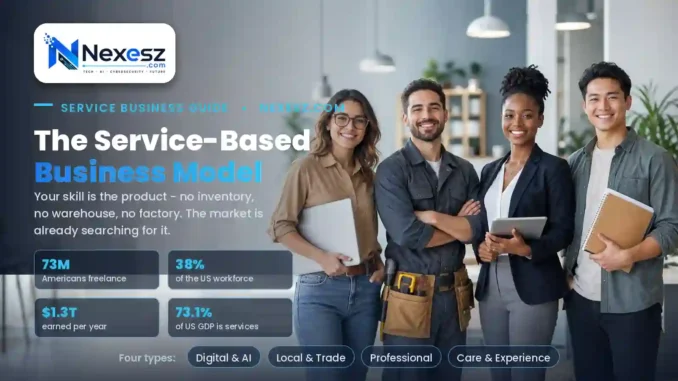
Before anyone sold software or manufactured goods at scale, people sold work: a haircut, a repair, a lesson, a proposal. The service-based business model is the oldest and still the most accessible way to start earning — no inventory, no warehouse, no factory. Your skill is the product, and the market is already searching for it. In 2026, about 73 million Americans freelance — 38% of the workforce — contributing roughly $1.3 trillion a year. This article explains how the model works, which ideas work now, how to land first clients with almost no money, and how to turn a one-person practice into a system. If you are new to the concept, it helps to start with what a business model is first.
What Are Service Businesses?
A service business sells work, expertise, or attention instead of a physical product. The customer pays for a task completed or a problem solved — from a haircut to a marketing retainer — and the business’s main asset is the skill of the people who deliver it.
The Four Types of Service Businesses
Service businesses fall into four groups:
- Digital — freelance writing, design, development, marketing (delivered online, scaled with systems)
- Local and field — cleaning, repairs, landscaping (scaled with crews)
- Professional — accounting, consulting, legal (sold on judgment)
- Care and experience — tutoring, coaching, pet care (bought for attention)
Most profitable businesses stay inside one group and get sharp first; the four cover most types of business models that sell time and skill.
Why Services Dominate the Economy
Services are not a niche; they are the economy. According to the US Bureau of Economic Analysis, private services-producing industries accounted for 73.1% of US GDP in the first quarter of 2026, and the service sector — the tertiary sector — is roughly two-thirds of global output. Independent work is the fastest-growing layer: 68% of companies now hire independent workers regularly, up from 48% in 2020. For a new business, demand is structural, not seasonal.
How a Service-Based Business Model Works
The Exchange: Time, Skill, and Attention for Money
A service transaction is simple: the client is short on time, skill, or energy, and pays to buy the difference. Three properties matter:
- Trust — the client buys judgment before results
- Consistency — the result arrives as promised, every time
- Price anchoring — value is set by the outcome, not the hours
The Natural Ceiling: Why Time-Based Revenue Gets Stuck
Because you are the product, your revenue is capped by your calendar. Ten clients at an eight-hour day is a ceiling, not a goal — and 30–40% of that day will never be billable: sales, admin, invoicing. This is why most service businesses follow the same arc: sell your time first, convert repeatable work into packages, then delegate delivery. The businesses that never make that conversion remain good jobs with invoices.
Pricing: Hourly, Project, Retainer, and Value-Based
A service-based business model can bill four ways:
- Hourly — easiest to start, hardest to grow
- Project pricing — a defined outcome at fixed scope
- Retainers — a monthly slice of the client’s work, the closest services get to recurring revenue
- Value-based fees — charging what the outcome is worth, not what the clock says
A 2026 survey of 900+ small business owners found 32.6% had no plans to raise prices even as costs climbed — while freelancers who set a calculated floor rate, covering costs, taxes, and unbillable hours, charge 40–80% more than those who guess. Mature businesses price projects and retainers, then move their best clients to value-based fees as proof accumulates.
Service-Based Business Ideas That Work in 2026
The best ideas share one trait: they solve a problem the client already admits to having.
Digital and AI-Leveraged Services
A service-based business model built on AI leverage is the fastest new-business play of 2026 — for a subtle reason. McKinsey’s State of AI found that 88% of organizations now use AI somewhere, and 77% of US small businesses use it regularly. Yet only about a third report any real profit impact from it. That gap is the business: companies have the tools but not the implementation skill. Workflow automation, AI chatbot setup, AI-assisted content, and industry-specific AI integration all fill that gap — and AI-related freelance hiring grew 109% year over year, more than 4x the rate of other in-demand skills. Virtual assistance demand is up 20%+ a year, and fractional CMO/CTO/COO roles let small companies buy expertise without full-time salaries.
Local and Trade Services
Digital is not the only winner: labor shortages are pushing demand and prices up for local work: home repair, landscaping, cleaning, mobile detailing, senior-care support, and pet care. They start with a phone, a van, and word of mouth, then scale with crews, routing software, and review management.
Professional and Productized Services
Bookkeeping, design retainers, video editing, content repurposing, and micro-agencies sit between the two. The 2026 pattern is productization: not “marketing,” but “30 posts, 4 reels, and a monthly report for a fixed fee” — fixed scope, price, and process, which makes the work sellable, deliverable, and delegable.
Landing Your First Clients
First clients are the hardest — and the most valuable: they define your offer, price, and process.
Pick One Offer for One Specific Audience
“I do social media, writing, and web design” is not an offer; it is a wish list. The businesses that get hired fast sell one tight outcome to one specific audience: “I write SEO blog posts for SaaS companies” or “I clean homes in a ten-mile radius.” Specificity creates credibility — clients buy certainty, and a narrow offer is easier to understand, price, and recommend. And you do not need paid clients to prove you can deliver: a handful of well-presented samples, in the freelance portfolio examples style, can open the first conversations.
Start With No Money: The Zero-Capital Playbook
Many beginners start with the search “how to start a business with no money,” and for a service business that search is answerable: your skill is the inventory, and it costs nothing. The zero-capital stack:
- A one-page website
- Canva
- Notion
- Free scheduling
- A payment link that only charges when you earn
The discipline matters more than the tools: a practical benchmark is sixty touches in week two, ten booked calls, and three paid clients by week three. Keep the money clean from day one — separate account, simple budget, on-time invoices — because cash flow, not talent, kills many new service businesses.
Outreach That Works
The numbers explain why most beginners stall. A typical marketplace job post attracts 20–50 proposals in 24 hours, and generic, templated submissions convert at 1–3% — while strategic, problem-first proposals convert at 15–25%. New freelancers often need 40–100 proposals before their first platform contract, so warm channels — your network, local businesses, content — deserve equal effort. Personalized beats templated, every time: state who you help, what problem you solve, and why it matters now — then ask for a conversation. The difference between “I am hardworking” and “I will raise your local rankings in 90 days” is what the Upwork proposal examples collection shows. With daily, targeted outreach, most new service businesses land a first paying client within four to eight weeks.
From Solo to System: How to Scale a Service Business
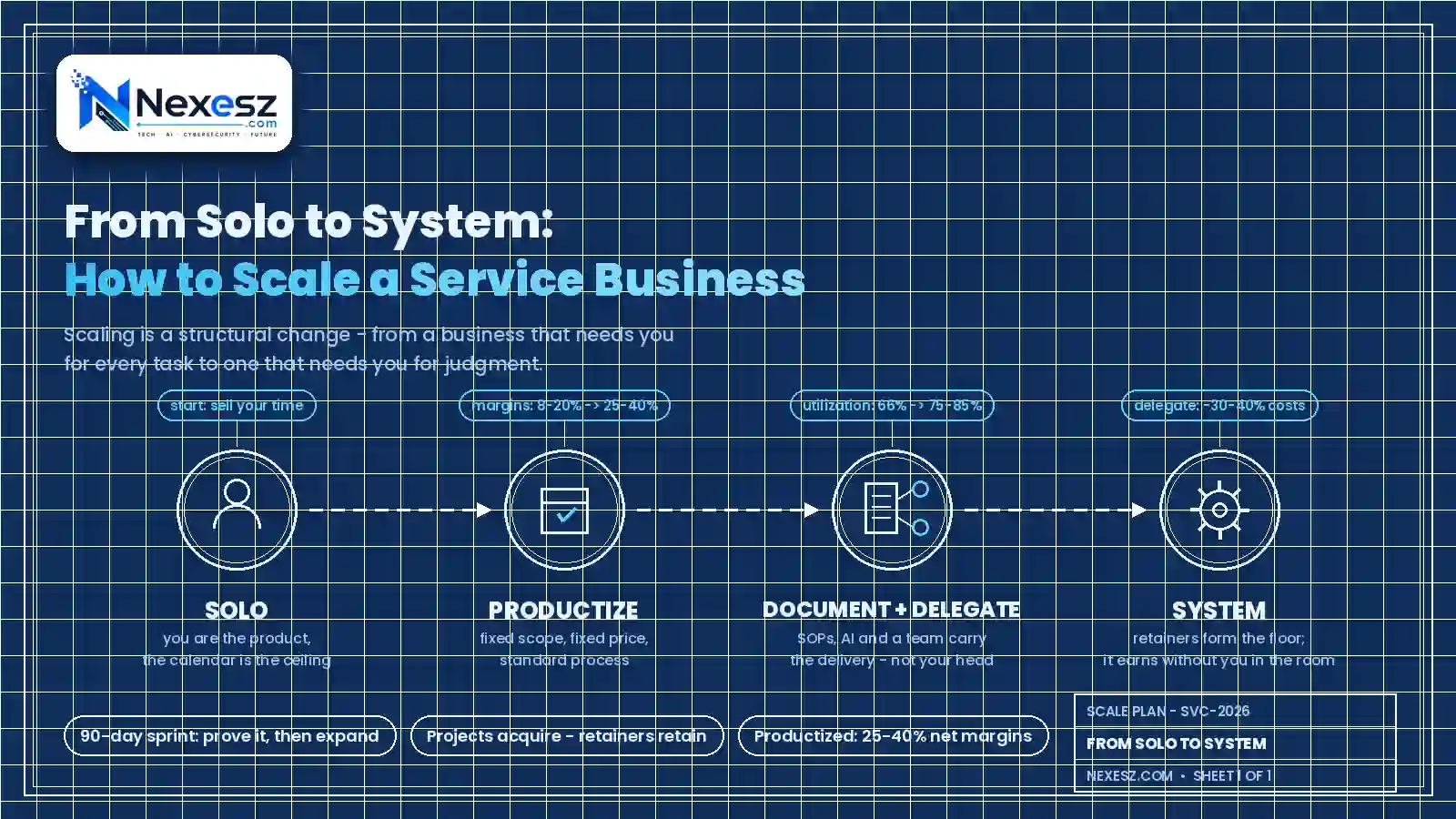
Scaling is not “more clients.” It is a structural change: from a business that needs you for every task to one that needs you for judgment.
Productize Before You Hire
Scaling a service-based business model starts with one move: productize your most repeatable service.
- Fixed scope — you do X, Y, and Z, and nothing else
- Fixed price — no “it depends”
- Standardized process — every client gets the same onboarding, milestones, and delivery
The economics: the average digital agency nets about 13% after expenses, and the split is telling — specialized, productized agencies run 25–40% net margins while generalists average 8–20%. The $500K-to-$2M stage is the classic founder bottleneck: below it, bespoke delivery is fine; above it, without productization, your time is a hard ceiling on growth.
Document, Delegate, and Use AI
Once the offer is a product, the process must live outside your head. If a task happens more than twice, it gets a standard operating procedure — a checklist, a recorded walkthrough, or a template. The math is blunt: the average professional-services business runs 66% billable utilization, and the healthy target is 75–85% — every recovered point is margin. Layer AI on top for drafting, research, scheduling, and support, and reserve your own hours for the work that actually requires you: client relationships, quality judgment, and new-offer design. Delegating specialized work can cut operating costs by 30–40%.
Recurring Revenue: Retainers and the Subscription Bridge
Projects create peaks and valleys; retainers create a floor. The next step is converting the best clients into monthly agreements: fixed hours, fixed deliverables, fixed price. That is where subscription business model logic enters services: predictable income, lower churn than project work, and revenue you can forecast. Recurring-revenue businesses also survive at higher rates — one more reason retainers are a scaling move, not a pricing preference. Many service businesses run two motions at once: one-off projects that acquire clients, and retainers that retain them.
The 90-Day Scaling Sprint
Pick one productized service and run a 90-day sprint: a funnel that sells it, SOPs that deliver it, and metrics — time, margin, client satisfaction — that prove it works. Before pricing anything, mapping the offer on a business model canvas makes the moving parts visible. When the sprint proves the numbers, expand to the next service. If it fails, you lost 90 days, not the business.
Service-Based Business Examples: What the Winners Look Like
Three patterns cover most successful service businesses.
The Freelancer-to-Agency Path
The classic arc: one person sells a skill, standardizes it, then hires other skilled people to deliver it while the founder handles sales, quality, and pricing. The service-based business model here shifts from selling hours to selling outcomes — the founder becomes a system owner, and revenue stops being tied to one calendar.
The Productized Service Studio
Designjoy is the proof that this model works at the extreme: one designer, no employees, a flat $4,995-per-month price, one active request per client at a time, 48-hour turnarounds — and over $130,000 in monthly recurring revenue. The pattern repeats: video teams selling “4 edited shorts per week,” dev shops selling “MVP in six weeks,” SEO firms selling fixed monthly packages. The client chooses a package, not a person; onboarding is automated, delivery is checklisted, and new team members can be trained in days. Margins stay high because nothing is custom, and growth is limited by sales capacity, not delivery capacity.
The Local Service Empire
Cleaning, landscaping, and home-repair companies scale differently: crews, routing, and reputation. The best ones systemize quotes and scheduling, train technicians on a standard process, and treat five-star reviews as a sales engine. The economics look unglamorous, but labor shortages keep margins expanding — and the moat is local trust, hard to import.
Conclusion
Start where you are: one skill, one offer, one audience, and the willingness to talk to clients. The service-based business model rewards the sequence — sell first, price from a real floor, systemize second, scale third. Keep the work repeatable, move your best clients onto retainers, and protect cash flow from day one. Do that, and the business stops being your job and becomes a system that earns whether or not you are in the room.
Frequently Asked Questions
What is a service-based business in simple terms?
You sell work, expertise, or attention instead of a product. The client pays for a task completed or a problem solved — your skill and delivery are the whole business.
Which service businesses are the most profitable?
It depends on skill and demand, but specialized services win: AI consulting and automation, productized retainers, and niche professional work pair high margins with near-zero startup cost. Locally, labor-short trades like handyman and landscaping earn well too.
How much money do I need to start a service business?
Often almost nothing. A phone, a free website, free planning tools, and a payment link are enough to start. Your first investment is usually outreach time, not capital.
Can I scale a one-person service business?
Yes — a solo design subscription clearing over $130,000 a month with zero employees proves it. The path: productize, document, delegate, and move the best clients onto monthly retainers.
Is a service business better than a product business?
For starting, usually yes: lower cost, faster first revenue, and direct client feedback. For the long run, many service businesses add products — templates, courses, or software — so the business can earn without the founder’s time.
Leave a Reply