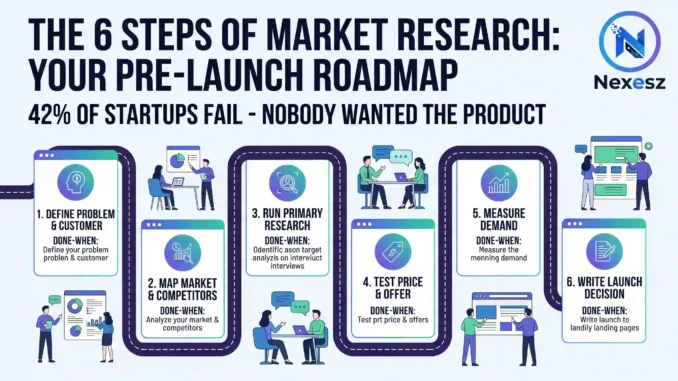
42% of failed startups die for one reason — nobody wanted the product. That is the number CB Insights keeps finding across more than 100 startup postmortems, and it is the most preventable cause on the list. The steps of market research that prevent it cost days of your time, not money. Roughly 80% of businesses launch with zero research, and in 2026, 44% of digital products on Gumroad have earned exactly $0 — the most dangerous part of your business is the part before launch, and it is also the cheapest part to fix.
Market Research Process Steps — Your Pre-Launch Roadmap
Here is the complete roadmap — six steps, in order, each with a done-when signal:
- Define the problem and the customer — one sentence, confirmed by three strangers.
- Map the market and the competitors — five competitors, their prices, your one-sentence gap.
- Run primary research on a zero budget — ten interviews, a 50–100 response survey.
- Test the price and the offer — the four price questions, real preorders.
- Measure demand with hard numbers — a landing page that strangers fill.
- Write the launch decision — launch, pivot, or kill — on one page.
Why Launching Before Research Is the Most Expensive Mistake
Entrepreneurs imagine the risk is in building. The data says the risk is in skipping research and hoping. Juicero raised $120 million for a Wi-Fi-connected juicer that customers could squeeze by hand. The product was built, branded, and launched — and the demand was never there. Studies put the stakes even more directly: up to 60% of business failures could be prevented with proper market analysis, and among startups that completed structured customer research, no-market-need failures drop from 42% to under 15%.
What an early launch actually costs you:
- Money and inventory — products, stock, and ad spend built on a guess instead of evidence.
- Months of your life — you end up fixing in year one what two weeks of interviews would have revealed.
- Trust — a failed first launch is remembered, especially in small online communities.
- Customer language — the words that sell your product can only come from people you actually talk to.
The stages of market research cost time, not money. That is the trade you are about to make.
The 6 Steps of Market Research to Complete Before Launching
Here is each step in full — with its done-when.
Step One — Define the Problem and the Customer
Write one sentence: “[Customer] is struggling with [problem], and right now they deal with it by [workaround].” If you cannot write that sentence, you do not have a business yet — you have a mood. Steve Blank built the entire customer development method around this idea: validate the problem before you build anything that solves it. Most failed launches actually fail in these first steps of market research, long before any code is written.
Done when: you can name the customer, the pain, and the current workaround in one sentence, and at least three strangers have confirmed the pain is real.
Step Two — Map the Market and the Competitors
Pick three to five closest competitors — not the giants, the shops a buyer would actually compare you against. Note their prices, their positioning, and the complaints in their one-star reviews. Those complaints are your gap. Size the market bottom-up: how many potential customers exist, and what would one of them pay in a year? Check the direction too — Google Trends shows whether searches for the problem are rising or fading. Before you map who beats you, make sure you understand what makes a business model work, so your niche connects to a clear way of earning.
Done when: you can list your five competitors with their prices and your one-sentence gap — without looking anything up.
Step Three — Run Primary Research on a Zero Budget
Interview five to ten potential customers for 20–30 minutes each. Ask about the problem, and never lead with “would you buy this?” Find people where they already gather — Facebook groups, Reddit threads, industry forums. Then run a short survey of 50–100 responses; a sample of 100 gives you roughly a ±10% margin of error, which is plenty for a launch decision. Skip your friends and family — they are the least honest sample you can get.
Of all the steps in the marketing research process, this is the one that separates evidence from opinion. Do it before the remaining steps of market research — every later step gets cheaper once the problem is real.
Done when: ten people describe the problem without prompting, and at least 50 survey responses are in.
Step Four — Test the Price and the Offer
Interest is not demand, and a price test turns opinions into evidence — a card on file beats a hundred compliments. Ask the four Van Westendorp questions — too expensive to consider, expensive but a bargain, cheap but maybe low quality, too cheap to trust — and let the crossover points set your price. Better than any survey: ask for preorders. When people put a card on file or a deposit down, the real answer arrives. One founder collected 50 preorders in 60 days before spending a dollar on stock.
If you are planning a recurring offer, test how a subscription business model works first — recurring revenue is easier to validate with a founding-member price than a one-time sale.
Done when: you have a defensible price range and at least a handful of committed preorders.
Step Five — Measure Demand With Hard Numbers
Now measure. Drive free or cheap traffic to a simple landing page that explains the offer and asks for an email or a preorder. One founder spent about €418 on Google Ads over two weeks and hit a 17% conversion rate before writing a line of product code — more than double the 6.6% median landing page rate. Another built a splash page for a VR product and collected more than 500 preorders before the product existed — Pebble and Oculus did the same thing on Kickstarter years earlier. If your page cannot collect 50–100 interested emails or preorders from real traffic, the message or the market needs work before you spend more on it. If you are building software, the same test decides whether to commit to a saas business model at all.
Done when: a stranger with money has committed to your offer at your intended price.
Step Six — Write the Launch Decision
Most founders stop at “the data looks good.” Do not. The last steps in the market research process are the ones founders skip most. Write a one-page decision document: summarize the evidence, then choose exactly one of three — launch, pivot, or kill. If the evidence supports a pivot, write down what changes. If it supports killing the idea, write that too — finding out in a month instead of a year is a win, not a failure.
Done when: the decision is written down, and you can defend it from the evidence.
What Are the Steps of Marketing Research — 5 or 6?
Many textbooks compress the classic framework into what some call the marketing research process 5-step model, folding “present the findings” and “make the decision” into one reporting stage. If you have typed what are the steps in the marketing research process into a search bar, you will see it too — six stages in some books, five in others. The count matters less than what gets dropped. When the decision stage is merged into the report, it disappears in practice: the research ends at a presentation, and nobody formally decides. Whatever the count, the steps of market research end the same way — with a written decision. That decision is the step that stops you from launching early, so keep it separate, even when your favorite framework does not.
Free Tools That Cover Every Step — 2026

You do not need a research budget. The free stack below maps onto the steps of the marketing research process one by one:
- ChatGPT or Gemini — turn interview notes into themes and patterns in minutes.
- Perplexity — competitor and market research with cited sources you can verify.
- Google Trends — see whether the problem is growing, flat, or fading, by region.
- AnswerThePublic — the exact questions your future customers are typing.
- Tally or Typeform — free surveys that take an afternoon to set up.
- Julius AI — analyze your survey data without writing a line of code.
- Hotjar — watch how visitors actually behave on your landing page.
- SparkToro — free audience searches to see where your niche hangs out.
In 2026, 88% of market researchers use AI-assisted analysis, and a validation project that once took three to six months now fits inside four to eight weeks.
Red Flags That You Are Not Ready to Launch
- Nobody will preorder. Praise is free; money is data. If no one puts a card on file, the offer is not proven.
- Everyone says “nice idea,” and nobody commits. Enthusiasm without action is a polite no.
- You cannot name the customer. If the answer to “who exactly buys this?” is “anyone,” the research is not done.
- No complaint pattern surfaced. Real problems leave trails in reviews and forums. Zero trails means a weak problem.
- The price is a guess. You have never asked the four price questions, so your pricing is decoration.
- The research was a poll of friends and family. That is the least honest sample available, and it always says yes.
If three or more of these are true, the honest answer is simple — you are not done yet. Negative signals are data too. A dry interview and a silent landing page are not bad luck; they are the research working.
What Launching Looks Like After the Research Is Done
A researched launch feels different from a hopeful one:
- The price is set by crossover points, not gut feeling.
- The messaging uses words customers actually said in interviews.
- Preorders are already banked before day one.
- The riskiest question — will anyone pay? — has a written answer, with evidence attached, from Step Six.
Every item on that list traces back to one of the steps of market research you completed.
Conclusion
You do not need money to do market research. You need one week of discipline. Define the problem, map the market, interview real humans, test the price, measure the demand, and write the decision before you build. The 42% who built things nobody wanted did not fail because they were unlucky — they skipped these steps of market research. Once the research is done, the next question is what to sell first, and the path to turning your skills into a profitable online business starts exactly here.
Frequently Asked Questions
How long does market research take before you launch a business?
About four to six weeks for a solo founder on free tools. Ten interviews, a 50–100 response survey, and a two-week landing page test make a realistic full cycle.
How much does market research cost for a small business?
Close to zero. Free tools cover interviews, surveys, trend data, and analysis; a landing page plus a small ad test can stay under $500.
How many customer interviews are enough before launch?
Five to ten solid 20–30 minute interviews is the working minimum. You are done when the same frustrations repeat, and the last three conversations add nothing new.
What is the first step in the market research process?
Defining the problem and the customer — one sentence naming who is struggling, with what, and how they deal with it today.
Do I need market research for a service business?
Yes — services fail the same way products do. Before setting your first price, understand how a service-based business model works, and validate demand with the same interviews and preorders.
Leave a Reply