
Sarah turned her graphic design skills into a full-time income. Mark, a former teacher, now sells online courses to students around the world. Priya runs business strategy sessions for a loyal group of clients. Jake sells the simple digital tools he builds in his spare time. A profitable online business no longer requires capital — it requires a skill that people already pay for. This guide walks through the practical steps to package your expertise, validate the demand, and build sustainable online income.
Your Skill-to-Income Roadmap
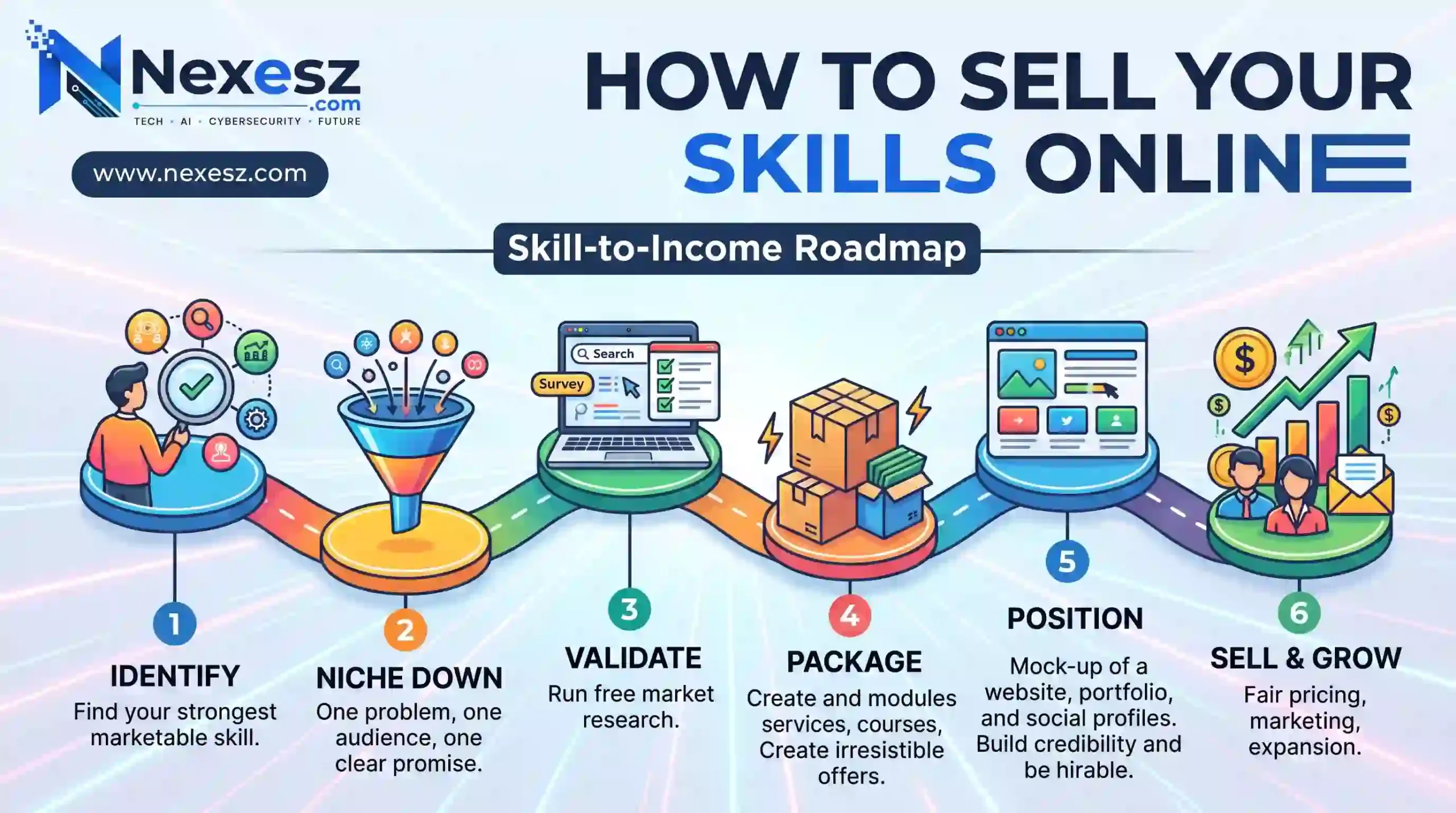
Here is the complete path — six moves, in order:
- Identify — a short self-assessment that finds your strongest, most marketable skill.
- Niche down — one problem, one audience, one clear promise.
- Validate — free market research before you build or promise anything.
- Package — turn the skill into services, digital products, or courses.
- Position — a website, portfolio, and profiles that make you look hireable.
- Sell and grow — fair pricing, useful content, and an email list that compounds.
Why Your Skills Have Business Potential
Every skill solves a problem, and people pay for solutions. The numbers back the move: in 2026, 76.4 million Americans freelance — a market worth roughly $1.57 trillion a year — and 45% of American adults run a side business that averages about $1,122 a month. A skill becomes a profitable online business when someone pays for that solution, and the freelancing economy is the fastest ramp into it. The market also rewards updated skills: freelancers working on AI-adjacent projects now earn about 44% more per hour, and 76% of freelancers already use AI tools, saving roughly 8 hours a week. The number of freelancers earning over $100,000 a year has grown 87% in just five years.
Before you compare opportunities, spend ten minutes on a quick self-assessment. Answer these four questions honestly:
- What comes easy to you? Write down three tasks or activities you find easy or enjoyable.
- What do others ask you for? List the skills people have complimented you on or requested your help with.
- What did you just solve? Think about the last time you helped someone fix a problem — which skill did you use?
- What does an outsider see? Ask a friend or colleague to name one strength they associate with you.
Jot the answers down and look for the repeat. That intersection — easy for you, requested by others — is where a profitable online business starts. To build a strong foundation:
- Identify your strongest, most specific skill.
- Research whether the market actually pays for it.
- Focus on solving one specific problem first.
- Improve your expertise every month, because rates follow proof.
Choose the Right Niche
Selecting a focused niche helps you attract the right audience and stand out from competitors. Rather than targeting everyone, choose one category where your knowledge can provide consistent value. If your goal is to learn how to start a profitable online business from home, the niche is the first decision you make.
When comparing online business ideas for 2026, weigh demand against competition. Online education is one of the largest pools — the global e-learning market is worth over $400 billion and still grows around 15% a year. Digital marketing services, health and wellness, pet care, and remote work tools keep offering opportunities year after year, because the problems behind them do not go out of fashion. Prefer evergreen problems over passing trends — a trend fades, but a problem your audience faces every week is a business that keeps running. Before committing, follow the steps of market research to check real demand, watch what competitors charge, and note the complaints in their reviews. A clear niche also makes it easier to build authority and rank in search engines, because you are known for one thing.
Plan Your Business Strategy
Every successful business begins with a clear plan: what you offer, who it is for, and how the value reaches the customer. Most people building a profitable online business skip this plan and then wonder why growth stalls. Decide your first offer — usually a simple service that fits your strongest skill — your target customer in one sentence, and one channel where that customer already spends time.
If your budget is zero, the plan gets even more important; the guide on how to start an online business with no money maps the exact sequence. And before you lock the offer, understand what makes a business model work, so the skill connects to a repeatable way of earning — not just a one-off favor.
Planning also keeps you honest about time: set a realistic weekly goal, track it, and review every four weeks.
Build Your Online Presence
A credible digital footprint is what turns a stranger into a client. Your online presence should include:
- A simple, professional website — a single page is enough to start.
- A portfolio or clear work samples.
- A contact page that answers within a day.
- One or two active social profiles, not five abandoned ones.
- Clear service information: what you do, for whom, at what level.
You do not need a designer or a domain budget — free site builders and LinkedIn can carry you for months. The goal is not a perfect site; it is a real place where a client can see your work and reach you.
Create Valuable Offers
People buy solutions rather than skills alone. Organize your knowledge into offers that solve specific problems, and match the offer to where you are:
- Freelance services — the fastest start for beginners; sell the skill directly and let reviews build your proof.
- Digital products and templates — for content creators; build once, sell repeatedly, and a tool that works well can grow into a saas business model that runs on autopilot.
- Online courses — for educators who can teach a repeatable outcome to many students at once.
- Consulting and strategy sessions — for professionals whose judgment is the product.
- Membership programs — for experts ready to trade one-off fees for a subscription business model of recurring revenue.
If you are starting with services, understand how a service-based business model works before you set your first price. A clear offer helps visitors understand exactly how you help, and it makes the business easier to promote.
How to Sell Your Skills Online
Once your offer is ready, the next step is reaching the right audience and pricing it properly. Selling online comes down to three things — presenting your services clearly, keeping a professional profile, and communicating the value you provide. A well-organized portfolio, clear pricing, and fast replies build confidence with prospective clients.
For pricing, use a formula, not a guess: take your target annual income, add 15–25% for taxes and expenses, divide by roughly 1,100 billable hours a year, and that is your floor. Beginners typically start near the lower end of their market range and raise rates as reviews accumulate — raise for new clients first, and tell existing clients 30–60 days ahead. Underpricing is the most common way a profitable online business stays small, because it attracts clients who want the most for the least. As your portfolio and testimonials grow, move from hourly to project or value-based pricing, where you are paid for the outcome, not the clock — strong freelancers charge 10–30% of the revenue their work creates for a client.
Use Free Tools to Grow Your Business
Starting does not require expensive software. The 2026 free stack covers almost everything:
- Canva — graphics, logos, and social posts from 1.6 million free templates.
- Google Workspace — professional email, documents, and sheets.
- Trello or Notion — tasks, client work, and planning.
- Tally or Typeform — free surveys to check what clients want.
- Brevo or MailerLite — free email marketing with room for a growing list.
- Google Analytics — see which pages actually bring clients.
- Julius AI — analyze survey data without writing code.
Using the right tools lets you work efficiently while keeping costs near zero — upgrade a tool only when it stops being enough.
Market Your Skills with Useful Content
Even excellent services cannot grow without visibility. To monetize your skills, publish useful content on a schedule: answer the questions your niche actually asks, solve real problems in short posts and videos, and stay consistent for months, not weeks. Video deserves extra effort — content with video lifts conversion rates by about 49%.
Build the habit in layers. First, publish high-quality content that ranks and answers. Then consider starting a blog that makes money as a long-term asset that brings visitors while you sleep. Pair content with an email list from day one — the list is the only channel you own, and it is where referrals, launches, and repeat clients happen.
Conclusion
Building a profitable online business starts with one skill, one problem, and steady weekly action. Identify what you do best, validate it for free, package it into a clear offer, and let content and search engines bring the clients. Success rarely happens overnight — but every month of consistent work raises your rates, your proof, and your options. If you are ready to turn your skills into a business today, start with the ten-minute self-assessment above and write down one simple service you could offer this week.
Frequently Asked Questions
What is a profitable online business?
A profitable online business generates consistent income by solving real problems with skills, services, or products while keeping operating costs low — often starting with free tools and no inventory.
How can I turn my talents into online income?
Identify your strongest skill, choose a focused niche, validate demand for free, package a clear offer, and promote it through your website, content, and a growing email list.
Which skills are most in demand for online income?
Writing, graphic design, coding, teaching, consulting, digital marketing, and web development remain the most sought-after — and AI-adjacent versions of almost any skill now command premium rates.
Do I need money to start?
No. Many people begin with free tools and low-cost platforms — a free website builder, a portfolio page, and freelance marketplaces — and only invest in paid resources once revenue arrives.
How long does it take to become profitable online?
Services can earn within a few weeks on freelance platforms. Content, courses, and products usually need three to twelve months of consistent work before they pay regularly.
Leave a Reply