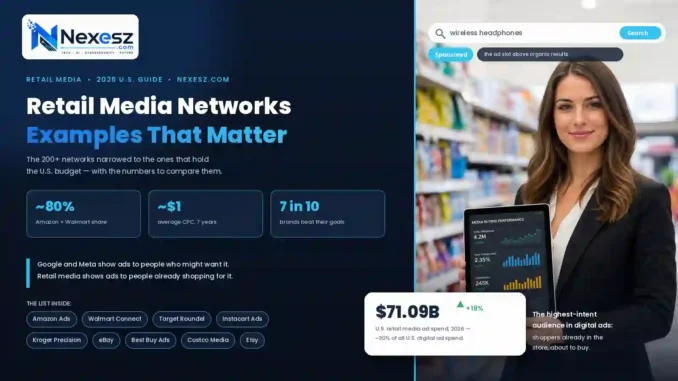
Here’s a number most online sellers never see: U.S. advertisers will spend $71.09 billion on retail media in 2026, up 18% from 2025 — roughly 30% of all U.S. digital ad spend. If you sell online in the United States, that’s the highest-intent audience you can reach: shoppers already in the store, about to buy.
So when people ask me for examples of retail media networks, they’re asking the right question and the wrong one at once. There are 200+ networks out there. You need the ones that hold the U.S. budget — and a repeatable way to compare them. This guide lists the retail media networks I use with U.S. sellers, includes 2026 numbers, and explains how to pick the right one.
What Is a Retail Media Network
A retail media network is an advertising platform run by a retailer. The retailer owns the property — website, app, or store — and owns the data: who bought what, when, and how often. It sells ad space on that property, targets it with that shopper data, and tells you whether the ad produced a purchase.
The formal retail media network definition sounds dry, so here’s the practical version: Google and Meta show ads to people who might want your product. A retail media network shows ads to people who are already shopping for it. That one sentence is the entire business case.
If the terminology is new, start with what a business model is — an RMN is the retailer’s revenue model for its own traffic, with 50–70% margins versus 5–10% on the products underneath. No wonder every major retailer is building one.
The data is the whole game. Retailers hold purchase history, loyalty accounts, and on-site search behavior — no cookies required. With cookie-based targeting fading, retail media now offers the cleanest targeting signal left in digital advertising.
Why Retail Media Is Where the Intent Is
The 2026 numbers are the reason to care:
- $71.09 billion — U.S. retail media ad spend in 2026, up 17.8% from $60.32 billion in 2025 (eMarketer)
- 89% of the $10.5 billion in new U.S. retail media spend in 2026 goes to just two networks — Amazon Ads and Walmart Connect (eMarketer)
- ~$1 per click — average cost per click, holding near a dollar for seven straight years (Skai)
- 7 in 10 brands meet or beat their retail media goals (Skai/Stratably 2026 survey of 166 advertisers)
And the structural shift: commerce media has passed TV as a share of global ad spending for the first time (WPP Media, December 2025), and 52% of advertisers are moving display budgets from open-web programs into retail media. Buyers are telling you where the money is going.
The Major U.S. Retail Media Networks
Amazon and Walmart alone take about 80% of U.S. retail media spend. The top retail media networks — the retail media networks examples that matter for a U.S. seller — look like this:
Amazon Ads — the default you can’t ignore
Amazon isn’t one of the options. It is most of the market: $68.6 billion in ad revenue in 2025, growing 22% into 2026, and three-quarters or more of all U.S. retail media spend.
What you get: Sponsored Products, Sponsored Brands, Sponsored Display, Amazon DSP (Prime Video and CTV), and Amazon Marketing Cloud for measurement.
Access is the easy part: if you sell on Amazon, Sponsored Products is open to you — no minimum spend, a suggested start of about $10 a day. That’s why every U.S. seller starts here, and why it’s the most competitive auction in the category. Expect clicks around $0.90–$1.12 and ACOS in the 25–35% range.
Walmart Connect — the omnichannel challenger
Walmart’s ad business hit $6.4 billion globally in fiscal 2026, up 46% — the fastest growth among the big networks. In June 2026, it bought streaming TV (Vibe.co, ~$1.4 billion), so the stack now spans on-site search, display, in-store screens, and CTV.
The differentiator is omnichannel measurement: Walmart can connect an online ad to an in-store purchase through loyalty data — the closest thing to proof in the industry.
Access is the second real route open to an independent seller: get approved on Walmart Marketplace and self-serve Sponsored Products opens up, with a reported $10-a-day minimum. For most small brands, that makes Walmart the logical second network after Amazon — new sellers get $500 in advertising credit before January 2027.
Target Roundel and the premium tier
Target’s Roundel generates nearly $2 billion in combined advertising value and a cleaner, brand-safe audience — beauty advertisers report around 5.1x ROAS, the highest of the big three.
The catch: access is managed, not self-serve. Roundel is invite-only through Target Plus, and much of the off-site programmatic runs through partners. If you’re not stocked at Target, you’re mostly out.
Instacart Ads and the grocery intent networks
Instacart Ads crossed $1 billion in U.S. ad revenue on basket-level grocery data, reaching about 95% of North American households across 100,000+ stores — your ad shows to a shopper building a cart, right now.
Kroger Precision Marketing is the other grocery heavyweight at roughly $1 billion, with the deepest CPG targeting in the business. CPG advertisers see a 4.8x median ROAS there, against 4.2x on Walmart Connect.
Both follow the same rule: the retailer has to stock your product. No distribution, no ads.
The mid-size options worth knowing
For a smaller seller, the mid-size networks are often the realistic entry points:
- eBay — the lowest bar in the group. Promoted Listings run cost-per-sale (2% floor, no minimum budget), plus a CPC option for Store sellers. 2026 warning: the “any-click” attribution change can charge you when a different buyer purchases after anyone clicks — read the terms.
- Best Buy Ads — approaching $1 billion in 2026, with self-serve access for Marketplace sellers and a reported 93% revenue-identification rate.
- Home Depot Retail Media — DIY and pro buyers; CPC on-site, managed programs and off-site audiences above it.
- Costco Media — high-spending bulk buyers, but managed access with reported $100K minimums. A brand play, not a startup play.
- Chewy and Etsy — niche audiences, niche results — strong if your category is pet or handmade/creative.
The pattern: most only sell to brands the retailer stocks. The marketplace-based ones are the ones you can reach on your own.

The Benefits of Retail Media for U.S. Sellers
If you’ve been collecting retail media networks examples from every podcast, here’s the filter that matters — the benefits of retail media networks are real, but only if your product can actually appear in the store:
- First-party data — targeting runs on real purchase history, not cookies. First-party activation is tied to up to 50% lower acquisition costs and a 10–15% revenue lift (Experian, 2026).
- Closed-loop measurement — SKU-level sales tied to your ad, often across online and in-store purchases. No more arguing about modeled attribution.
- Purchase intent — the shopper is searching, browsing, or in a cart. That gap is why these auctions command a premium over open-web display.
- In-store reach — where the retailer has stores, the network can place ads on screens and tie them to loyalty IDs.
- Off-site extension — about 18.7% of U.S. retail media spend is off-site, using the retailer’s data to target shoppers across the web.
One honest caveat: the 50–70% margins belong to the retailer, and the auctions get more competitive every year. This isn’t a free lunch — it’s better-measured, higher-intent paid traffic.
How U.S. Sellers Should Compare the Networks
Most sellers compare brand names. You need to compare six things:
- Access — Do you have to sell on the marketplace, or does the retailer stock you? Marketplace-based networks (Amazon, Walmart, eBay, Best Buy) are open to sellers; stocked-only networks (Target, Instacart, Kroger, Costco) don’t. Check this first.
- Cost — retail media runs on clicks and impressions: cost per mille (CPM) and cost per click (CPC). Expect CPCs near $1 on the big networks, CPMs in the $20–60 range on off-site and in-store inventory, and no published minimum on the marketplace self-serve tools.
- Return by category — published 2026 benchmarks put electronics near 10x ROAS on Amazon, CPG at 4–5x on Walmart and Kroger, and beauty at 3–5x depending on the network. Benchmark your category, not the average.
- Audience and data depth — a grocery loyalty file, a marketplace shopper graph, and a premium brand audience are three different tools. Match the data to where your buyer shops.
- Formats — on-site search, display, CTV, in-store screens, off-site programmatic. More formats mean more ways to be useful — and more ways to waste budget.
- Measurement and tools — attribution window (14 days versus 30), self-serve versus managed, and analytics depth. Closed-loop SKU data beats pretty dashboards.
Then layer your competitive picture on top: which networks are your rivals already buying on? A structured competitor profiling pass shows you the auction pressure before you spend a dollar. And if you’re still building the store the ads will drive to, the e-commerce playbook covers the fundamentals.
Where to Start
Here’s the sequence I’d run:
- Start where you already sell. If your product is on Amazon, Sponsored Products is your first test — the only major network with no extra gate. Run it for at least 90 days against your category’s ACOS benchmark, not your hopes.
- Add the second marketplace. Get approved on Walmart Marketplace and open self-serve Sponsored Products. Less auction pressure than Amazon, omnichannel measurement, and advertising credit for new sellers.
- Then chase the stocked networks. Instacart, Kroger, Target — in the order your distribution actually reaches them. No shelf? Work the shelf first; the ads are worthless without it.
- Match the test to your product. Replenishment categories (supplements, pet food, beauty refills) live in the grocery networks — that’s what subscription business model buyers do: reorder, again and again. One-time purchases win on search-first marketplaces.
Two habits decide whether the test works. Listing quality first: the same discipline that makes high-quality content rank makes a listing convert — images, copy, reviews, price all do ad work before the click. Know your buyer second: run the market research steps before scaling, and know which types of business models the channel fits — retail media rewards product businesses hardest.
The practical takeaway from all these retail media networks examples: access first, budget second.
The Bottom Line
Retail media is no longer a big-brand channel. The comparison, it turns out, is simpler than it looks:
- Access is filter number one — you can’t buy into most of these networks without selling to the retailer.
- The big two hold the budget — Amazon and Walmart take about 80% of U.S. retail media spend; the mid-size networks hold the niches.
- Compare on data, measurement, and category ROAS — not on brand names.
You don’t need to memorize the internet’s catalog of retail media network examples. You need the one network where your buyer already shops, a 90-day test against your category’s numbers, and the discipline to expand only when the math holds.
Frequently Asked Questions
What does retail media mean in simple terms?
A retailer selling ad space on its own store, using its own shopper data to target it. If you buy a sponsored placement on Amazon search or Walmart.com, you’re buying retail media.
Which retail media network is best for small sellers?
The one you already sell on. For most small U.S. brands, that’s Amazon Sponsored Products first, then Walmart Connect once Marketplace approval lands — the two major networks with a real self-serve route.
How much does advertising on a retail media network cost?
Mostly per click, near $1 on the big networks, plus CPM pricing on display, in-store, and CTV. Self-serve marketplace tools have no meaningful floor — Amazon suggests about $10 a day. Managed premium programs run $10K–50K a month; Costco sits well above.
Do I need to sell on a marketplace to use its retail media network?
Usually, yes. Amazon, Walmart, eBay, and Best Buy open their ads to sellers; most of the retail media network examples you’ll read about — Target, Instacart, Kroger, Costco — require the retailer to stock your product first.
Are retail media networks worth it compared to Google and Meta?
For purchase intent, yes — closed-loop data beats modeled attribution, and a ~$1 click is cheap next to a median Google search CPC near $4.66. Not a replacement, though: they’re the layer closest to the purchase, and the best plans run both.
Leave a Reply