Most failed products die of a quiet, preventable cause: the founder built for a problem that was real in their head and invisible in the market. This guide walks through the consumer research methods that catch that mistake before code, inventory, and ad spend do the rest of the damage.
The Cost of Building Before You Know
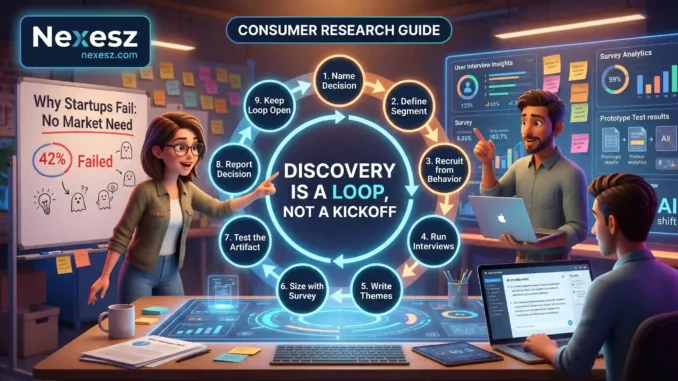
CB Insights has published post-mortems from 483 dead startups, and 42% of them failed because nobody wanted the product. Another 29% ran out of cash. Their 2024 update on 431 VC-backed failures puts poor product-market fit at 43%.
The Bureau of Labor Statistics says 20.4% of U.S. businesses fail in their first year and 49.4% by year five. Startup Genome goes further, with roughly 90% of innovative startups never finding traction.
I’ve watched teams ship a full build in six weeks, then spend four months discovering the problem was smaller than their feature list. The build is expensive; the research that would have stopped it is cheap. That gap is the whole argument in this article.
Consumer Research Methods at a Glance
Consumer research methods are the structured ways teams learn what real people actually do, need, and pay for — before they commit to a build. In 2026 the industry is bigger than most founders realize.
Global market research services reached $96.77 billion in 2026, up from $93.37 billion in 2025, and are projected to hit $116.02 billion by 2030 at a 4.6% CAGR. ESOMAR counted $153 billion in global insights-industry turnover in 2024, an 8% jump, with the U.S. alone spending about $48 billion a year.
You don’t need that industry’s budgets. The methods it built are documented, cheap, and fast enough for a solo founder:
- User interviews — 8 to 20 one-on-one conversations that surface the real job, the trigger, and the current workaround
- Surveys — structured questions that size the problem and test willingness to pay at scale
- Focus groups — 6 to 10 people in a moderated room; great for reactions, expensive per insight
- Observation — watching people use their current solution where they use it; beats asking what they’d do
- Prototype and landing-page tests — cheap artifacts that measure real behavior instead of stated intent
- Behavioral data — search terms, app-store reviews, and sales records showing what people already bought
- AI-moderated interviews — the 2026 newcomer that cuts conversation costs by an order of magnitude
Qualitative Techniques That Reveal the Why
Qualitative consumer research techniques answer the why behind the numbers. They’re also the cheapest consumer research methods a solo founder can run, which is why they come first. A classic 15-to-20 interview study ran $40,000 to $65,000 all-in when contracted to an agency.
In-depth interviews run 8 to 20 participants, and a strong human analyst gets through 8 to 12 of them in a single day. Ethnography runs smaller still, 5 to 15 people observed in context. Focus groups are the fastest read on language, but at $7,000 to $20,000 per group they’re a spend you justify with a decision waiting on the other side.
The method survived for decades for a reason: it works. Interview people who used the last solution, not people who like ideas — and ask about last Tuesday, not hypotheticals. The questions you ask decide the quality of everything that follows.
The Customer Research Questions That Matter
After a few hundred conversations, these are the questions that keep paying for themselves:
- What is the current workaround? If the answer is nothing, the problem may be weaker than it feels.
- When did it last hurt? A recent, specific pain beats a general complaint.
- What did you already try to fix it? Money spent on a fix is the strongest signal that the problem is real.
- What would you pay, and when? Stated willingness to pay is weak evidence; behavior is not.
- Who else has this problem? If only the people you invited do, the market is you.
Before the first call, run the competitor profiling process we published. Half the time the gap you’re after is already documented, and it takes one afternoon.
Write these down before every conversation. Change the order, but don’t invent the conversation in the field.
Quantitative Surveys and the Response Problem
Of the consumer research methods on this list, surveys are the only one that scales by itself, and the math is unforgiving. The average survey response rate sits around 33% overall and has slipped 1 to 2 points every year. Linked email invitations, the workhorse channel, return 6% to 15% of the people you send them to.
Plan samples accordingly: a few hundred completed responses in one serious segment signals problem frequency and willingness to pay, while broad market sizing is cheaper from secondary data. My own rule is to keep a survey under 10 questions; past that, completion drops and the answers you care about stop being honest.
Surveys don’t replace conversation. They confirm or deny it at scale — a different job, and a cheaper one.
Consumer Research Examples From Real Companies
Seeing the method at company scale makes it concrete. Sweetgreen rebuilt its menu research with AI-moderated interviews and ran it at a third of the traditional cost, with five times the responses and five times the speed. Microsoft’s Frontier Listening effort in early 2026 ran more than 250 AI-conducted interviews across three audiences to shape product direction.
A founder-scale version of the same playbook fits a weekend: interview 8 people who bought the last solution in your category, ask the five questions above, and write the recurring theme in one sentence. If you can’t, the product is not ready. That is a complete example of consumer research, small enough to finish before the motivation fades.
The point is not the tooling. Teams that keep shipping the right thing treat discovery as a standing activity, not a one-time kickoff. If you’re building the model around what you learn, start with the fundamentals in our guide to what a business model actually is.
Behavior Patterns Behind Purchase Decisions
Where market research and consumer behavior meet is where most product bets live. People don’t buy reasons; they buy patterns that already exist in their week. The pattern you’re interrupting, not the feature you’re adding, decides whether anything lands.
Four behaviors worth measuring:
- The switch, not the purchase — people change brands for smaller reasons than they adopt a category
- The anchor product — new purchases attach to something already in the routine
- The refund and churn moments — where people leave tells you what the category does not respect
- The stated-versus-observed gap — stated preference and actual clicks disagree; trust the clicks
Sellers already in the market get a head start; our guide to starting a profitable e-commerce business shows where that data hides inside your own store.
The line people draw between consumer insights vs market research is mostly organizational. Insights come from behavior; research comes from questions. The strongest teams run both on the same product decision.
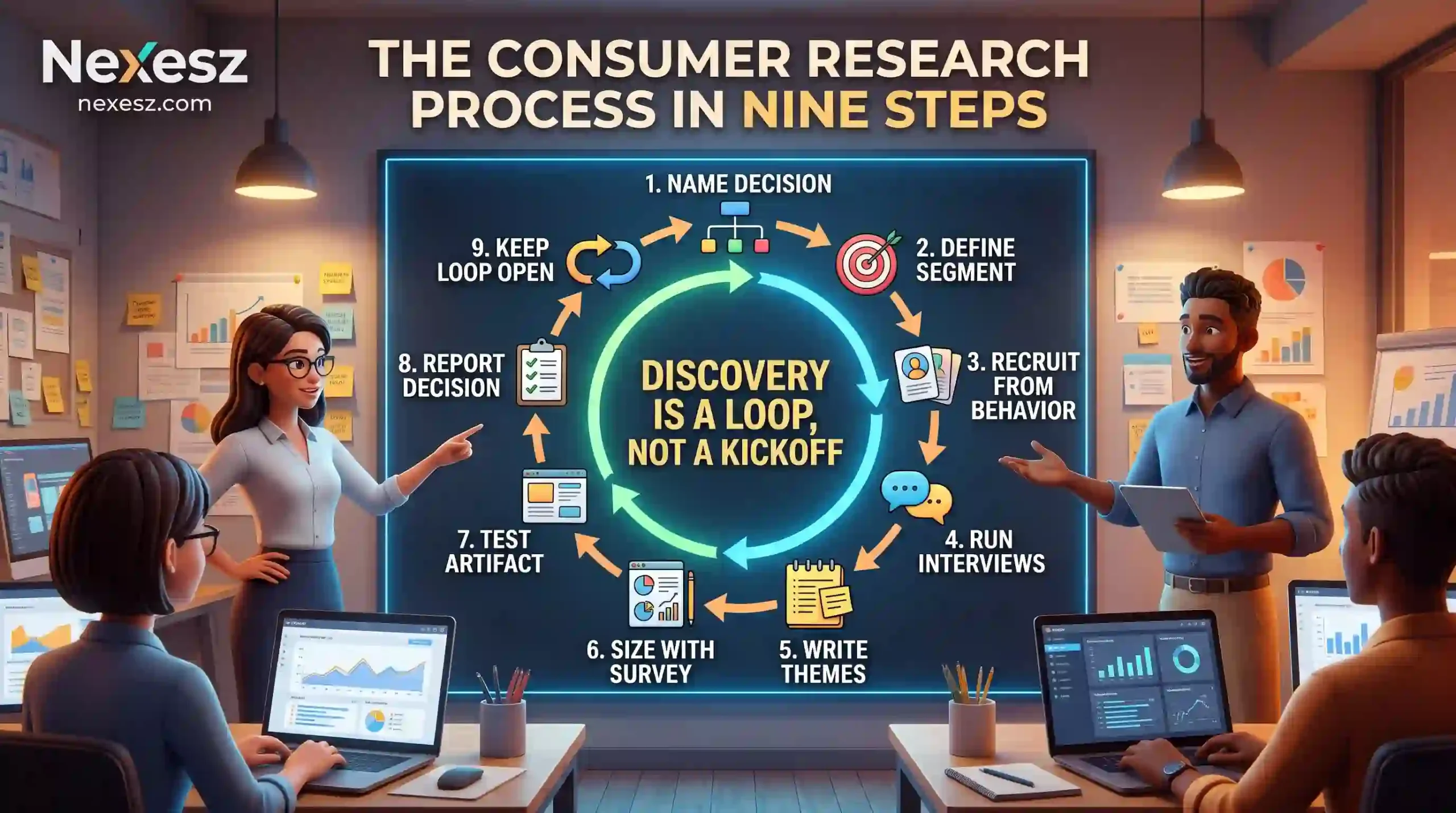
The Consumer Research Process in Nine Steps
The sequence below is the loop, and it loops:
- Name the decision — every study exists to answer one call: build, kill, or pivot
- Define the segment — narrow enough that one person’s answer predicts a hundred others’
- Recruit from behavior — people who acted on the problem beat people who talk about it
- Run the interviews — 8 to 20 conversations with the question set above
- Write the themes — one sentence per theme, with verbatim quotes beside it
- Size with a survey — a few hundred responses to confirm frequency and willingness to pay
- Test the artifact — a landing page or prototype against real behavior
- Report the decision — build, kill, or pivot, with the evidence attached
- Keep the loop open — ship the smallest version and let usage data restart the cycle
The short answer to how to gather consumer insights is that you mix small qualitative samples with continuous behavioral signals, in that order. Consumer research in marketing works both directions — discovery shapes the offer, and early numbers feed the next round — so the steps above follow the sequence in our market research steps guide.
The AI Shift in Consumer Research
The cheapest disruption in the category is already here, and it changes the economics of consumer research methods. Quirk’s 2025 benchmarks put an AI-moderated interview at $8 to $15 per completed conversation, against $150 to $300 for a human-led one, with completion rates of 87% versus 34%. ProductPlan’s 2026 survey found 40% of B2B SaaS product teams running AI-moderated interviews monthly, up from under 10% in 2024.
The time math is where it stops being a cost story. Median time-to-insight in a panel study is 26 days; in an AI conversation study it’s 3.2 days, and cost-per-insight is down 71%.
A human analyst reads 8 to 12 interview transcripts a day while AI tooling chews through 50 to 100. MIT Sloan’s 2026 review is blunt about what LLMs do to timelines, compressing months into days.
For a small team the entry price is trivial: $20 to $30 a month on a general AI tier, or $50 to $100 on an AI-assisted survey platform.
The risk is not cost. It’s that fast, cheap insight starts to feel like truth, so the loop still ends with a human making the call. For SaaS teams specifically, the loop plugs straight into the pricing and churn levers we break down in our SaaS business model guide.
The Signal to Stop Researching
Research that is still paying for itself has a signature: you stop finding new themes, interviews start repeating, and the decision itself gets boring. That is the moment to switch from discovery to delivery.
The opposite signal is worse: you’re running round after round because each one keeps changing your mind, you can’t commit to a decision, or you’re still interviewing people you invited rather than people you found.
When research says go, the rest is execution. The paperwork side of that handoff is covered in our business fundamentals guide.
The Bottom Line
Building before you know is the most expensive way to learn what a market does not want. The consumer research methods in this guide are old, cheap, and documented, and the 2026 AI layer just cut their cost by an order of magnitude.
- Run the loop — small samples, questions about last week, decision in writing
- Trust behavior over statements — the clicks and the receipts outrank the compliments
- Keep the loop open — the first shipped version is round two’s interview data
The full sequence sits inside the wider roadmap we published in our modern online business guide. Discovery is its first chapter, not the footnote.
Frequently Asked Questions
What is consumer market research?
Consumer market research is the process of studying a defined market — who is in it, what they buy, and why — before you commit product or capital to it. It is broader than product discovery, which is one slice of it aimed at a single build decision.
How much does consumer research cost for a small team?
DIY with general AI tools runs a few tens of dollars a month, and an AI-assisted survey platform adds another slice. Agencies used to charge five figures for a small interview study, which is exactly the gap the 2026 tooling closed.
How long does a consumer research project take?
A focused single-segment loop — interviews plus one confirming survey — fits two to three weeks; the AI conversation layer has compressed the interview half to a few days of review.
Do I need a research panel to get started?
No. Panels matter when you need a fast, demographically specific sample at scale. For the first decision, people you recruit from behavior in your niche, plus a landing-page test, cover the job.
When is enough research enough?
When new interviews stop producing new themes and your decision stops changing. If five straight conversations confirm what eight before them already showed, the marginal value of a ninth is low — the build is where the next evidence comes from.
Leave a Reply