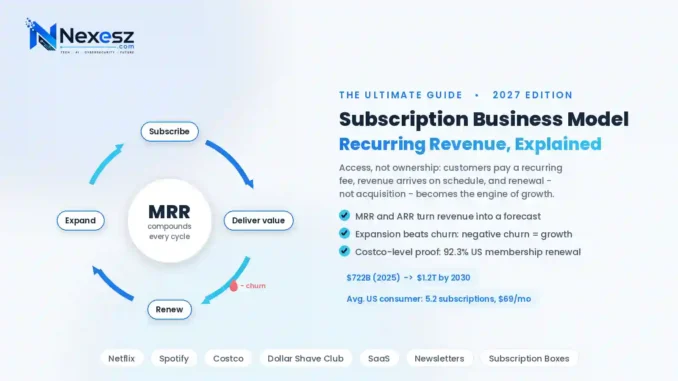
The tools people use every day are rarely products they own — they are access they rent, month after month. The subscription business model now sits behind a roughly $722 billion global economy, and the number is still compounding. It trades a single sale for an ongoing relationship, and that trade changes how a company plans, prices, and grows. This article explains how the model works, the metrics behind it, and when it is — and is not — the right choice. If you are new to the concept, it helps to start with what a business model is first.
What Is a Subscription Business Model?
Under this model, customers pay a recurring fee — weekly, monthly, or annually — for ongoing access to a product or service. Revenue arrives on a schedule instead of in one lump sum, and the relationship continues until the customer decides to cancel.
The idea is older than the internet: 17th-century publishers of books and periodicals pioneered it, and today the same structure powers streaming platforms, software, meal kits, and warehouse clubs. It is one of the most proven types of business models, and the one most closely tied to predictable income.
A 2023 Harvard Business School study found almost 75% of consumer-facing companies now offer subscriptions in some form. The core exchange is simple: the customer pays to use, not to own.
How It Works: Pay for Access, Not Ownership
Three mechanics make it work. First, automated billing: a pre-authorized charge renews the subscription each period without a new sale. Second, continuous delivery: value must arrive every cycle. Third, renewal as the default: if the payment works and the customer has not canceled, revenue simply continues. That third point is the entire engine. A business with 1,000 subscribers at $30 a month does not have to find 1,000 new buyers every month; it has to keep its base healthy.
Subscription vs One-Time Payment
| Dimension | Subscription | One-time payment |
|---|---|---|
| Revenue pattern | Recurring, predictable, compounds | One-off; restarts with every new sale |
| Customer relationship | Ongoing, multiple touchpoints | Ends at purchase |
| Acquisition cost | Amortized over the customer’s lifetime | Paid in full for every sale |
| Lifetime value | Grows with each renewal | Fixed at the transaction price |
| Main risk | Churn erodes the base | No retained revenue between sales |
A May 2026 Bango survey of 2,500 US consumers found the average American carries 5.2 subscriptions, spends about $69 a month on them, and would sit through twice as many ads to lower the cost.
The Renewal Moment: Where Revenue Is Won or Lost
Every renewal is a quiet re-purchase. Renewal friction — surprising price hikes, expired cards, weak onboarding — leaks revenue. The stakes are measurable: a March 2026 BSA consumer survey found budget concerns are the most common reason Americans cancel, while 93% rank easy cancellation among the top benefits of subscriptions. Transparent pricing and frictionless cancellation are retention tools, not concessions.
Key Characteristics of a Subscription Business
Five traits separate this model from transactional businesses. In a subscription business model, growth is a simple equation: new customers plus expansion, minus churn.
Recurring Revenue: MRR and ARR
Monthly Recurring Revenue (MRR) is the predictable income from active subscribers each month; ARR is MRR multiplied by 12. A company with 1,000 customers at $100 per month sits at $100K MRR, or $1.2M ARR. Investors value subscription companies as multiples of ARR precisely because this number forecasts the next year, and a Chargebee 2025 survey found 96% of subscription businesses expect growth, two-thirds by more than 20%.
Churn: The Leaky Bucket
Churn is the share of customers or revenue, lost each period. At 5% monthly churn, you lose half your base every 13 months without acquiring anyone. The best businesses treat churn as a dial they can turn: Spotify cut premium churn from 3.9% to 3.5% over two years while growing its base from 276 million to 300 million premium subscribers — retention work and growth happening at the same time.
Expansion Revenue and Negative Churn
The best subscription businesses also grow existing customers: added seats, upgraded tiers, extra usage, or a second monetization layer. When expansion outpaces the revenue lost to churn, the company reaches negative churn — it grows even without new signups. Netflix’s ad-supported tier is an expansion play: existing subscribers monetized a second time without leaving.
The Metrics That Run a Subscription Business
- MRR / ARR — the predictable base; momentum measured month over month.
- Churn — how fast the base erodes; the first number to watch.
- LTV — the total revenue a customer delivers over their lifetime.
- CAC — the cost to win one customer; LTV should cover it several times over.
- NRR — net revenue retention: do existing customers expand faster than they leave?
Why the Subscription Model Keeps Winning
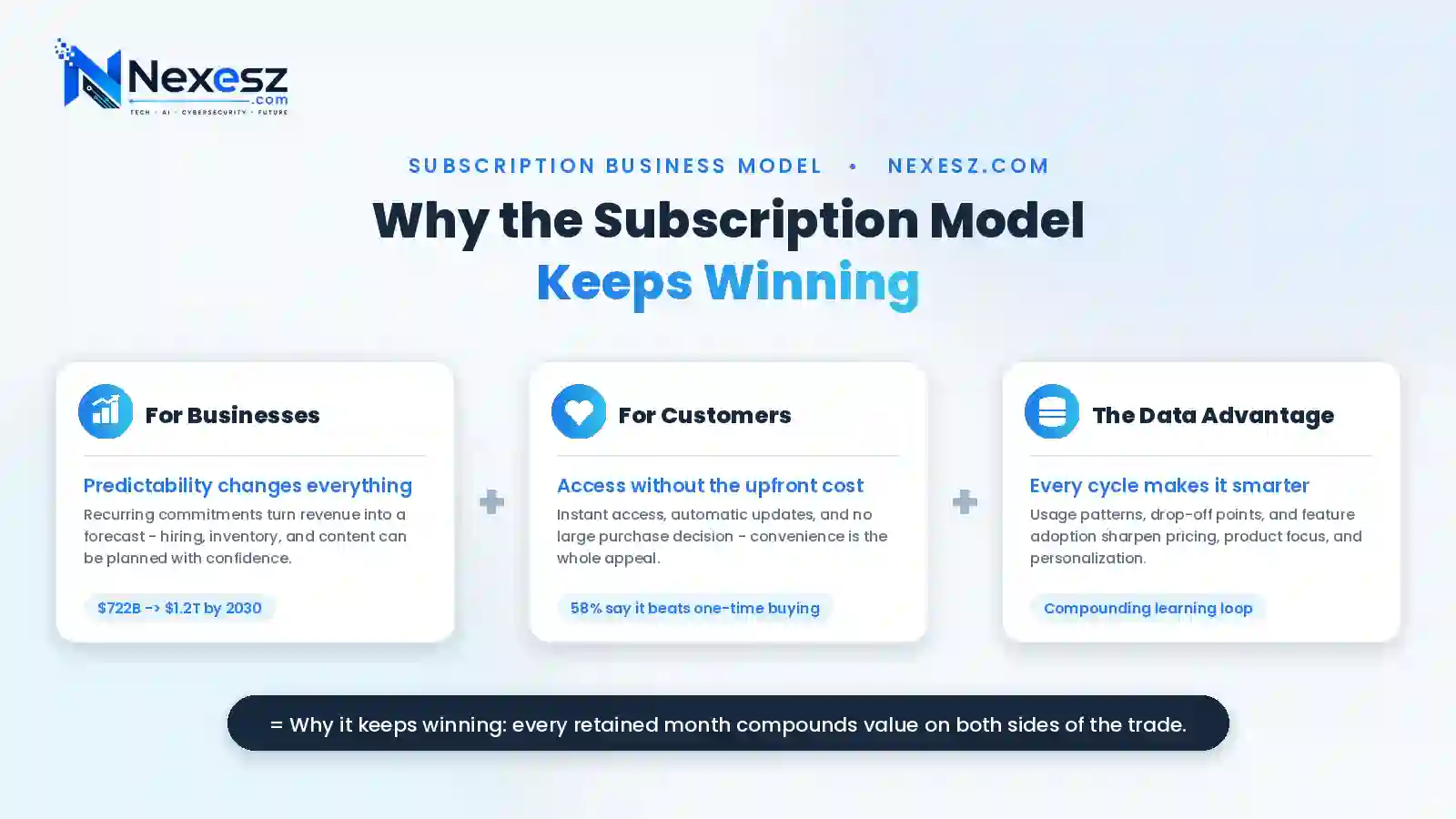
Why is the subscription model so popular? The answer comes from both sides of the trade, and it compounds. For the business, recurring commitments turn revenue into a forecast. For the customer, access without ownership removes the upfront cost. And the subscription business model compounds that advantage: every retained month adds to lifetime value, and usage data makes the product better each cycle.
For Businesses: Predictability Changes Everything
The global subscription economy was valued at around $722 billion in 2025 and is projected to pass $1.2 trillion by 2030, with subscription e-commerce alone approaching $860 billion in 2026. Predictability — not just size — is the point: recurring income lets companies plan hiring, inventory, and content with a confidence transactional businesses cannot match.
For Customers: Convenience, Access, and Lower Upfront Cost
Customers trade money for convenience: instant access, automatic updates, and no large purchase decision. A March 2026 BSA consumer survey found 59% of American consumers prefer a discounted longer-term subscription over a flexible month-to-month one, and 58% agree subscriptions beat one-time purchases overall. The data also shows the limit of the trade: consumers underestimate what their subscriptions cost, which is why easy cancellation — the top-rated benefit — remains the price of admission.
The Data Advantage
Every renewal cycle generates data: usage patterns, drop-off points, feature adoption. That data sharpens pricing, product focus, and personalization in a way one-time sales never could.
How Subscription Businesses Make Money
A subscription business model earns through four mechanisms, and mature companies usually combine them.
Pricing Tiers and Plan Design
Most businesses offer two or three tiers — a low entry plan that removes friction, a core plan that carries most revenue, and a premium or business tier with more seats, features, or service. Tiers let light users in cheaply and heavy users pay more, without one price trying to serve everyone. The structure also sets the stage for price increases: Chargebee’s 2025 report found 70% of businesses raised prices the previous year, and the companies that did it well aligned the increase with visible new value.
Monthly vs Annual: The Commitment Discount
Annual plans are the fastest-growing lever. Roughly 30% of subscription users paid annually in 2024; by 2026 the share is pushing 50%. The discount is only part of the story — annual plans lock in price against increases, collapse twelve monthly decisions into one, and cut involuntary churn from failed payments.
Add-Ons, Upsells, and Expansion Revenue
Between renewals, the revenue base can still grow: extra seats, premium add-ons, usage overage, or an upgrade triggered by a team moment. This expansion revenue carries no customer acquisition cost, and it is what pushes net revenue retention above 100%.
Beyond Software: Memberships, Boxes, and Productized Services
The same mechanics work outside digital. Membership fees, curated boxes, replenishment deliveries, and productized services — a flat monthly fee for scoped work — all run on the same renewal engine, and the subscription box market alone is projected to grow from roughly $50 billion in 2026 toward $100 billion by 2030. For anyone building a modern online business, subscription pricing is often the first monetization step worth testing.
Subscription Business Model Ideas
The pattern transfers to almost any category where value repeats or a product is consumed.
Digital: SaaS, Newsletters, and Creator Subscriptions
Software is the clearest case — the SaaS business model remains the strongest proof that access beats ownership. Beside it, paid newsletters, course libraries, creator communities, and API services all monetize the same way, with a near-zero marginal cost per subscriber.
Physical: Replenishment, Boxes, and Product-as-a-Service
Consumables convert naturally: razors, coffee, pet food, supplements, meal kits. Analysts call this the convenience variant — the customer never has to remember to re-buy — and from Dollar Shave Club to Birchbox, businesses were built on it. The risk is operational: logistics, returns, and the customer who simply stops wanting the box.
Services: Retainers, Memberships, and Productized Work
Local and professional services fit too: gyms, cleaning, lawn care, bookkeeping, design retainers. The subscription frame turns irregular service income into a plan with a start date, a scope, and a renewal — which is what makes small-service businesses predictable.
Real-World Examples That Prove the Model
Subscription-based business model examples span almost every industry.
Netflix and Spotify: Access at Scale
Netflix counts 325 million paid subscribers across 190 countries, generated $45.2 billion in 2025, and added an ad-supported tier that 250 million people use every month. Spotify reached a 300 million premium-subscriber milestone in 2026 — a record for any audio streaming service — with premium subscriptions delivering around 90% of its €4.8 billion second-quarter revenue. Both prove the access logic: value arrives continuously, so the fee justifies itself month after month.
Dollar Shave Club: Replenishment Done Simply
Dollar Shave Club turned razor blades — a product bought irregularly at a drugstore — into a $1-to-$9 monthly delivery. The result: $200 million in revenue before Unilever acquired the company for $1 billion. The lesson is structural: recurring delivery converts a one-off purchase habit into a relationship.
Costco: The Membership at the Core
Costco inverts the assumption that merchandise is the business. Its fiscal 2025 numbers tell the story: $270 billion in net sales on a roughly 3% merchandise margin, while $5.3 billion in membership fees from 81 million paid members produced more than half of its operating income. Its renewal rate sits at 92.3% in the US and 89.8% worldwide. When the membership is the product, retention becomes the entire strategy.
Benefits of the Subscription Model
The benefits of subscription model adoption show up on both sides of the ledger:
- Predictable cash flow — recurring income makes forecasting, hiring, and investment planning possible.
- Higher lifetime value — each retained month adds revenue on top of the original acquisition cost.
- Lower customer barrier — access pricing removes large upfront purchases.
- Compounding data — usage patterns improve product, pricing, and retention over time.
- Valuation premium — investors pay multiples of recurring revenue that transactional businesses do not receive.
When Subscriptions Don’t Fit: The 2026 Reality Check
Choosing between the subscription business model and one-time pricing is a fit question, not a trend question.
When the Subscription Model Works
It fits when value genuinely repeats: updated content, ongoing hosting or support, consumed products, or services on a schedule — and when customers value convenience enough to pre-authorize a charge. If you are testing it for a new venture, mapping the offer on a business model canvas makes the fit obvious before you price a single plan.
When One-Time or Hybrid Makes Sense
2026 brought a visible pushback: subscription fatigue has made buyers compare total annual cost against one-time alternatives, and one-time purchases are rebounding in categories where the product is static. Buyers now accept recurring fees for live services and consumables, and reject them when the fee feels disconnected from ongoing value — 70% of consumers say they are open to usage-based pricing instead. Where doubt exists, hybrid pricing — an upfront fee plus optional recurring extras — often wins trust faster than either pure option. And before choosing, remember that pricing is only one part of business fundamentals: the offer has to earn the renewal, not just collect it.
Conclusion
In the end, the subscription business model turns a sale into a relationship with a meter attached. Subscriptions provide the predictable base, expansion keeps the base growing, and renewal discipline decides whether the revenue compounds or leaks. Choose the structure that matches how your customer actually experiences value — then protect retention, because in recurring revenue, keeping customers is the entire game.
Frequently Asked Questions
What does a subscription model mean in simple terms?
You pay a fixed fee at regular intervals to keep using something. When you stop paying, access stops — that ongoing exchange is the whole model.
Is a subscription better than a one-time purchase?
For the business, subscriptions usually mean more predictable, higher-value revenue. For the customer, they mean convenience and lower upfront cost — if the value keeps arriving.
How do subscription businesses reduce churn?
They onboard fast, communicate value regularly, price transparently, make cancellation easy, and use win-back offers at the moment of cancellation.
Can a local or service business use a subscription model?
Yes. Gyms, cleaning services, bookkeeping, and even lawn care run on memberships and retainers. The structure works wherever the service repeats on a schedule.
What is a healthy churn rate?
It depends on the category, but most businesses treat low single-digit monthly churn as healthy. A useful rule: churn above 5% per month means you lose half your base within a year without new signups.
Leave a Reply