
Starting an online store is no longer a leap of faith — it is a measured business decision. US online retail hit $326.7 billion in the first quarter of 2026 alone, up 9.8% year over year, nearly three times faster than total retail (US Census Bureau). Yet the same data tells a cautionary tale: only 10 to 20% of new stores reach profitability in their first year, and the leading cause of failure is poor product selection — not weak marketing. This guide walks the full path to start an e-commerce business that actually turns a profit.
Why E-Commerce Is a Smart Business Choice
Online retail keeps outpacing everything else in the US. In Q1 2026, e-commerce sales grew 9.8% while total retail grew 3.9%, and online shopping now accounts for about 17% of all US retail spending (US Census Bureau). Cyber Monday 2025 set a record at $14.25 billion in a single day. The e-commerce model also has structural advantages over brick-and-mortar:
- Lower operating costs — no rent, fewer staff, smaller overhead
- Flexible working hours — the store runs while you sleep
- Wider customer reach — a national market from day one
- Easy expansion — add products, not square footage
- Multiple selling opportunities — marketplace, social, and your own store
One 2026 shift: traffic to US retail sites from AI tools grew 693% year over year. Shoppers ask chat tools for product recommendations, and stores with clear product data win those referrals. No budget needed to begin — the start an online business with no money guide maps the zero-cost path.
Choose the Right Business Model
Your model decides your inventory risk, startup costs, and daily workload before you sell a single item. First, understand what a business model is, then pick from these options:
- Dropshipping — about 27% of online stores now use it. Fast to launch, but generic stores run 10 to 20% gross margins.
- Private label — branded products command 25 to 45% margins, and US private-label brands already account for roughly 21% of consumer goods.
- Print on demand — customers pay about 20% more for personalized products, and you never hold inventory.
- Handmade goods — a craft edge mass sellers cannot copy, and one of the cleanest ways to turn your skills into a profitable online business.
- Digital products — software, templates, or guides that sell once and deliver repeatedly; a digital catalog billed monthly runs on a subscription business model of recurring revenue.
Match the option to your budget, launch with one model, and get the systems right before adding categories.
Find Products Customers Want
Product selection decides everything — it is the number one reason new stores fail, ahead of marketing and money. Before you stock or list anything, research:
- Market demand — is the category growing, and how big is it?
- Customer reviews — what do buyers of the top products complain about?
- Competition — who is selling it, and how crowded is the search?
- Pricing opportunities — where is the margin between supplier cost and what buyers accept?
- Seasonal demand — will the product sell for twelve months or four?
Run it the disciplined way. Follow the steps of market research to size the demand, then run a quick competitor analysis on the five stores already selling the product. Their reviews reveal what buyers want and what the market has not given them; three-star reviews in particular point to the feature you could beat on day one.
Build a Professional Online Store
Trust is the conversion engine: about 70% of buyers say reviews and store presentation decide whether they trust a shop enough to pay. And it must work on a phone — mobile drove 56% of holiday online transactions.
Keep the essentials in place:
- Home page with a clear value proposition
- Shop or product listing page
- About page with a real story
- Contact page
- Privacy, shipping, and refund policies
Then work the two levers that move conversions the most: page speed — a one-second mobile improvement has been tied to up to 27% more conversions — and honest, complete product information.
Select the Best Platform
The platform is the foundation under your e-commerce business; migrating off it later means rebuilding pages, redirects, and sometimes rankings. In 2026, two names dominate: WooCommerce powers about 33% of all e-commerce sites worldwide, and Shopify holds roughly 29% of the US e-commerce software market.
Weigh what matters for your situation:
- Shopify — from $39 a month; the fastest path to launch with the cleanest paid-ads tracking.
- WooCommerce — a free plugin, but real costs run $75 to $6,500 a year with hosting, themes, and plugins; deepest SEO and content control.
- BigCommerce — from $39 a month; built-in B2B and wholesale features.
If search visibility is central, the best platform for SEO e-commerce for you is the one that controls titles, URLs, and product data without a developer.
Create Product Pages That Convert
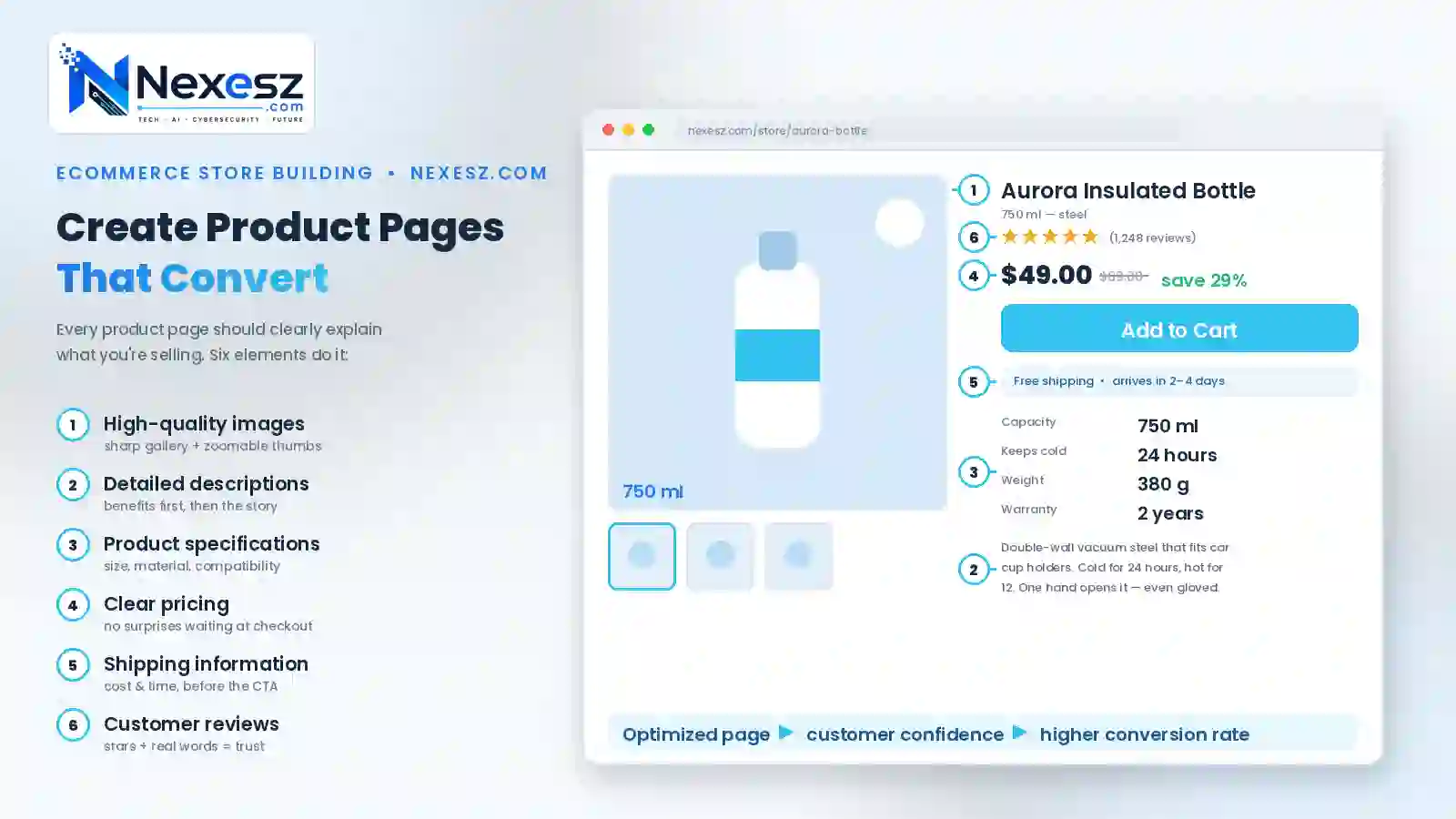
Benchmarks keep this honest: the average e-commerce conversion rate sits around 2.5 to 3.0%, the median Shopify store converts at 1.4%, and the top 20% clear 2.7%. Most of that gap is product-page quality, not traffic. Every product page should carry:
- High-quality images — multiple angles, real scale, lifestyle shots
- Detailed descriptions — benefit first, specifications second
- Product specifications — the answers buyers compare
- Clear pricing — including what is free, like shipping or returns
- Shipping information — timeframes and costs before checkout
- Customer reviews — and a visible way to leave one
Capture the email on every visit: email traffic converts at 4 to 6% — the highest of any channel — and the list keeps paying when ad costs rise.
Improve Your Store with SEO
SEO is how an e-commerce business earns repeat visits without paying for them. Know the field: 56% of US shoppers begin product searches on Amazon while 42% start on Google, so product discoverability decides who gets found.
The essentials, in order of impact:
- Write unique product descriptions — never copy manufacturer text.
- Use clear page titles and meta descriptions.
- Optimize product images with descriptive alt text.
- Keep URLs simple and user-friendly.
- Improve loading speed, especially on mobile.
- Build internal links between related products and guides.
Learning how to rank for e-commerce is a compounding habit, not a one-time project. Publish high-quality content that answers buyer questions, keep product data fresh, and watch AI answers — recommendation chat tools now send a fast-growing share of shoppers to retail sites.
Market Your Online Store
A launch is a beginning, not a growth strategy. The channels that earn their keep for a new store:
- SEO — the slow compounder covered above.
- Email marketing — the highest-converting channel you own.
- Social media — stores with at least one active social channel average 32% more revenue.
- Content marketing — buying guides and comparisons that build trust before the sale.
- Paid advertising — useful once a product has proven it converts.
If writing is your strength, starting a blog that makes money in your product niche is the cheapest way to be recommended — by people and by AI answers.
Use the Right Ecommerce Tools
Tools should remove repetitive work, not replace the strategy. The reliable starter stack costs little:
- Canva — product graphics and social posts.
- Google Analytics 4 — where visitors come from and where they leave.
- Google Search Console — the queries your pages rank for.
- Trello or Notion — orders, suppliers, and tasks in one place.
- AI writing tools — drafting descriptions and outlines, always edited by a human.
When volume grows, the best tools for content for e-commerce are the ones that keep your voice consistent across hundreds of product pages — a style guide and a description template beat five different apps.
Choose Reliable Shipping Solutions
Shipping is a purchasing decision, not back-office plumbing: buyers weigh delivery speed and cost the same way they weigh price, and slow delivery is a top reason customers do not return. When you compare carriers and services, check:
- Delivery speed — what can you promise honestly?
- Shipping costs — flat rate, free over a threshold, or item-based.
- Tracking — real-time, in plain language.
- International reach — only if demand justifies the complexity.
- Return handling — an easy return policy lifts conversion and trust.
Sourcing geography matters as much as the carrier: stores that keep bestsellers in a domestic warehouse report roughly half the customer complaints of stores shipping direct from overseas. Compare the best e-commerce platforms for shipping in your category before launch.
Conclusion
Choose products with real demand, pick one model and one platform, build a store that loads fast and reads honest, and let SEO and email compound. The stores that become profitable are rarely the fanciest — they made product selection, page speed, and shipping promises non-negotiable. Start with the product research this week.
Frequently Asked Questions
How do I start my first e-commerce business from scratch?
Pick a category with verified demand, choose a model that fits your budget, build a simple store on Shopify or WooCommerce, and promote it through SEO, email, and one social channel.
How much money do I need to launch an online store?
Less than most think. Dropshipping or print-on-demand can launch for under $1,000, including platform fees and a test budget; private label typically needs $500 to $2,000 for samples, branding, and first stock.
What is the best platform for an e-commerce business?
Shopify for speed and built-in features (from $39 a month), WooCommerce for SEO control and lower fees at low volume, BigCommerce for B2B and wholesale. Match the platform to your skills, not your ambitions.
How can I make my e-commerce business profitable?
Hold gross margin at 20% or above, control ad spend with conversion tracking, raise prices before cutting quality, and focus repeat revenue on email — stores that master retention out-earn stores that master acquisition.
Can I build a profitable online store with no experience?
Yes. The barrier is no longer technology — it is product selection and consistency. Start with one model, five products, and one channel, and treat the first ninety days as a paid education.
Leave a Reply