Starting a blog is simple these days. The hard part is building one that earns. There are over 600 million blogs on the internet, 7.5 million new posts go live every day, and only about 14% of bloggers make any income at all. If you want to learn how to start a blog that actually functions as a business, the difference is in the plan: the niche you pick, the content you publish, the SEO that compounds, and the income streams you wire in early. This guide walks through each step with 2026 numbers, so you know what the data says before you invest a year of your time. In short, a blog that makes money is built the way any small business is built — research first, then product, then distribution.
Why Blogging Still Pays in 2026
The audience is large and it keeps reading. HubSpot’s data puts blog readership at 83% of internet users — roughly 4.4 billion people — and the US alone hosts more than 32 million bloggers. Businesses take it seriously too; companies that maintain a blog report 67% more leads and 55% more website visitors, and marketers who prioritize blogging are 13 times more likely to report positive ROI.
The honest counterweight: Ahrefs estimates more than 90% of web pages receive zero organic traffic from Google, and most new blogs never pass their first 18 months. The bloggers who earn are not the ones with the best writing. They run the blog like a small media business — one focused topic, a consistent schedule, income streams designed in from day one. That is the bar this guide works toward: a blog that makes money by design.
Step One — Choose a Niche You Can Own
The blog niche decision shapes everything else. The first question is simple: can this topic support a blog that makes money? Most beginners fail it in one of two ways — a topic they love that nobody searches for, or a topic with huge volume they know nothing about. A workable niche sits where three circles overlap:
- You — you have genuine interest or direct experience, so you can write a year of posts without running dry.
- Demand — people actively search for answers in this space, and the searches have buyer intent somewhere in the funnel.
- Money — advertisers, affiliate programs, or customers will pay for access to this audience.
Work through the overlap before you write a single word. List three topics you could cover for 52 weeks. Check search demand with free keyword tools — you want steady volume with competition you can realistically rank against. Then verify the money: can you name three affiliate programs or paid products in the space? If the answer is no, the topic is a diary, not a business.
Apply the same market research steps you would for any startup idea, then study ten to twenty established blogs in the space. Note what they ignore and what they answer poorly — that gap analysis is competitor profiling in its simplest form, and it tells you exactly which corner of the topic you can own.
Step Two — Domain, Hosting, and WordPress
Your domain name is the blog’s identity: short, easy to spell, tied to your topic. Register it, add reliable hosting, and the site can be live in an afternoon. Budget the real costs before you start — the business fundamentals of any online business apply: a domain runs about $12 per year, shared hosting $5–15 per month, and there is no significant expense before your first post.
WordPress is the default choice for a reason: it powers 42.6% of all websites and hosts tens of millions of blogs, and its ecosystem supports every tool this guide references. For the setup itself, a clean checklist is all you need:
- A fast, mobile-first theme — pick one that loads quickly and looks professional without heavy customization.
- An SEO plugin — Rank Math or Yoast, so titles, meta descriptions, and sitemaps are handled from post one.
- SSL enabled — most hosts include the certificate free; it is non-negotiable for search and trust.
- Core pages — About, Contact, and Privacy Policy, so the site reads like a real publication.
- Analytics from day one — you cannot improve what you do not measure.
A well-organized site earns the visitor trust that turns first-time readers into returning, eventually buying, readers.
Step Three — Write Content People Actually Want
Good content is the key to a successful blog, and the 2026 data is clear about what works. The average post runs about 1,400 words, but posts over 3,000 words earn roughly three times the organic traffic, per Semrush’s analysis. At the same time, 73% of readers skim rather than read, which means structure is as important as substance:
- Solve one problem per post — a post that answers one question well outperforms five posts that graze a topic.
- Lead with the answer — state the key point in the first 100 words, then earn it with detail.
- Use real examples and first-hand experience — your own challenges and lessons are the raw material generic content cannot copy, and Google’s quality systems reward exactly this.
- Format for skimming — short paragraphs, clear subheadings, bolded key points.
- Link your posts together — every new article should point to at least two older ones, which builds a site readers move through instead of a collection of islands.
Cadence matters more than volume. 44% of bloggers publish three to six times a month, and one well-researched article per week beats several thin ones. The difference between content that ranks and content that doesn’t is explained in the high-quality content guide — the short version is depth plus accuracy plus a point of view. At this scale, a blog is doing what content marketing does for businesses: earning attention by being useful before asking for anything.
Step Four — SEO That Compounds
Writing is half the job; visibility is the other. The 90% zero-traffic number from above is the reason most blogs stay invisible — and the moat for those that break through. Organic search drives about 53% of all website traffic, and the top five results on page one take 67% of the clicks.
The on-page work is a checklist you run on every post:
- One primary keyword — placed naturally in the title, the H1, the first paragraph, and one subheading.
- Meta title and description — written to be clicked, not just indexed.
- Image alt text — descriptive and specific, which also earns image search traffic.
- Clean URLs — short, readable, and matching the keyword.
- Fast load times — slow pages are punished by search and by ad revenue alike; pages that take over three seconds to load can lose roughly half their mobile ad earnings.
- Mobile experience — the majority of blog traffic now arrives on phones.
Then think in years, not weeks: only 5.7% of pages reach the top ten search results in their first year. The compounding habit is updating old posts — refreshes can lift a post’s organic traffic by as much as 106%, and roughly one post in ten quietly gains traffic for years. Treat the blog as the center of a small content marketing strategy; each post targets one search query and earns traffic long after the writing is done.
Step Five — Monetize From Post One
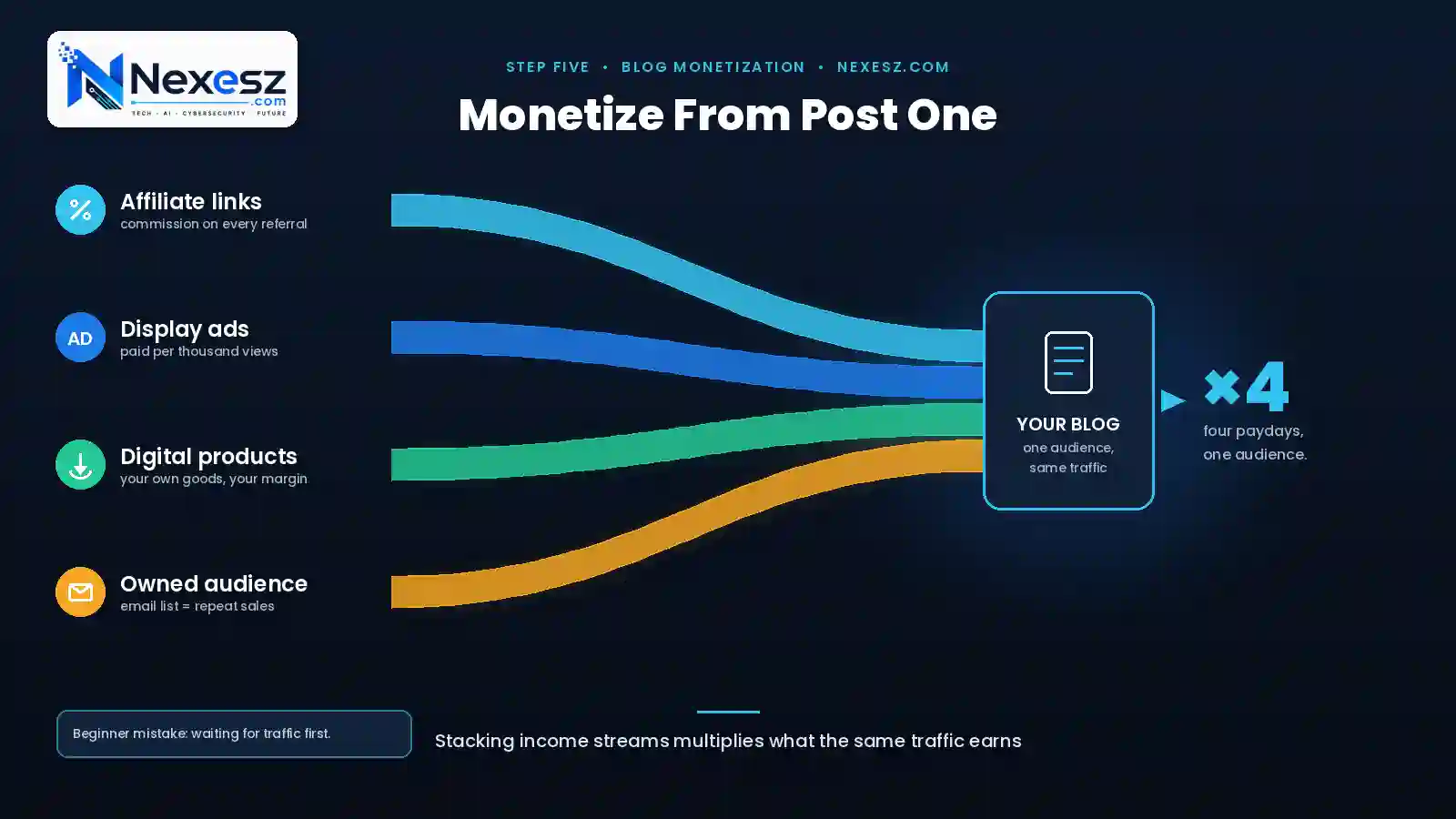
The most common beginner mistake is treating blog monetization as a phase you reach after you have traffic. The working order is the reverse: design the income, then build the audience that fills it. Diversified bloggers earn about 2.5 times more than those relying on a single stream, so stack from the start:
- Affiliate links — from post one. Recommend tools and products you actually use. Programs in SaaS and finance pay recurring commissions of 20–40%, which means the same post earns again every month.
- Display ads — once traffic allows. Google AdSense is the entry point, typically $2–8 per 1,000 pageviews; premium networks like Mediavine and Raptive pay $15–50 per 1,000 but require 50,000–100,000 monthly visits to qualify.
- Digital products — the highest-earning stream. The 2026 Blogging Income Survey found bloggers whose main income is digital products earning roughly $280–535 per 1,000 pageviews, against about $33 for ad-led blogs — the same audience, ten to sixteen times the money. An ebook, template pack, or short course works at a tiny audience size.
- Sponsored posts — at the top end. Brands typically start paying meaningfully around 10,000 monthly pageviews, and rates roughly triple past 50,000.
One asset outranks all of them: the email list. Search traffic can be taken by an algorithm update; an email audience belongs to you. Put a capture form on every post from day one, offer something small in exchange, and treat the list as the business’s actual foundation.
If your product needs a store, the e-commerce playbook covers the same fundamentals. Starting with zero budget? The no-money guide shows the leanest path. Growing out of your expertise? Turning your skills into a service is often the fastest first dollar.
The honest timeline, from the 2026 Blogging Income Survey of 129 monetized bloggers: the median blogger earns their first dollar at 12 months (the mean is 21), just over a quarter earn something within six months, $1,000 per month typically takes one to two years, and a full-time income averages about four years. Bloggers with 100 to 300 published posts average close to $2,000 per month — volume and patience doing the work.
Step Six — Promote Where Your Readers Are
Even the best article won’t reach readers on its own, and search alone is slow. Run a second distribution engine alongside it:
- Pinterest — still the strongest channel for visual niches like food, DIY, fashion, and travel, with pins that keep sending traffic for months.
- LinkedIn — the natural home for business, finance, marketing, and career content.
- Communities — answer real questions in Reddit threads and niche forums where your readers already gather; one useful answer beats five posted links.
- Guest posts — one well-placed article on an established blog in your space can outperform weeks of your own promotion.
- Repurposing — one long post becomes social snippets, a newsletter issue, and short-form video; the content does five times the work.
Search finds you slowly and for years; social and community find you now. Both matter.
The First 90 Days
Set small, verifiable goals instead of a vague ambition to “grow”:
- Days 1–30 — niche decided, domain live, WordPress configured, 5–8 cornerstone posts published, email capture on.
- Days 31–60 — two posts per week, three affiliate programs joined, Pinterest or LinkedIn active with a fixed schedule.
- Days 61–90 — first digital product outlined, your three oldest posts refreshed with new data, and the analytics reviewed for which posts earn clicks.
If you hit all three milestones, you have the skeleton of a blog that makes money — and you have finished more in ninety days than most blogs finish in a year.
The Bottom Line
A blog that makes money is not a writing exercise — it is a small business built on compounding. Pick the niche, build the site properly, publish content worth clicking, make it findable, and wire in income from post one. Expect 6–12 months before the first real money and 1–2 years before it is meaningful, and measure progress in posts published and readers returning rather than in this week’s revenue. Do that, and the same posts that took you four hours to write will keep paying for the next decade.
Frequently Asked Questions
How long does it take for a blog to make money?
Most bloggers see their first earnings around 12 months, with a quarter earning something within six months. Reaching $1,000 per month typically takes one to two years of consistent publishing and promotion.
Can I start a blog with no money?
You can start for under $20 — a domain and basic hosting are the only hard costs before content. Free tools cover keyword research, and affiliate links can be added from the very first post, so monetization costs nothing to begin.
What blog topics make the most money?
Finance, insurance, legal, technology, and health commands attract the highest-paying advertisers and affiliate programs. The best topic for you is the one where that money overlaps with your own experience and interest.
Is WordPress the best platform for blogging?
For income-focused blogs, yes. WordPress powers 42.6% of all websites, supports the SEO plugins and ad networks this guide references, and gives you full ownership of your content — something hosted platforms can revoke.
How many posts do I need before monetizing?
There is no minimum — affiliate links and email capture work from post one. Display ads need real traffic, and digital products need trust, so the practical sequence is affiliates first, products second, ads third.