
Let me start with something most content guides won’t: publishing more is not the play. I’ve watched sites pump out three posts a week and flatline, while a site with 40 genuinely useful pages quietly holds page one. Google no longer rewards volume. It rewards helpful, accurate, engaging information that meets what the searcher actually needs. The 2026 data makes this blunt — after its helpful-content updates, Google reported a 45% drop in low-quality, unoriginal content appearing in results, and in the March 2026 core update (the most volatile one it has ever shipped), 68% of sites with real E-E-A-T signals gained rankings.
So here’s what this guide covers: how to create high-quality content that ranks — the planning, the research, the structure, the on-page basics, and the refresh cycle that keeps a page earning long after publish day. I’ll flag where I think the old advice is now wrong.
Understand What Google Values
Google wants the most helpful answer for every search — and it isn’t counting keywords anymore. It checks whether your content answers the question clearly, whether the details are accurate, and whether a human actually enjoyed reading it. Search engine optimization is the practice of matching your pages to that standard, and in 2026 the standard has a name: E-E-A-T — Experience, Expertise, Authoritativeness, and Trust.
That first E is doing most of the work now. Here’s what caught my attention in the March 2026 update data: pages with original data gained +22% visibility on average, while AI-paraphrased pages — same facts, different words — got pushed out of the results. Google isn’t punishing “AI” there. It’s punishing sameness.
When creating high-quality content, start by identifying what your readers want to learn. Meet that intent and the rankings follow, because Google measures satisfaction, not keywords.
A strong article should include:
- Clear structure — headings, short paragraphs, a logical flow someone can skim in five seconds.
- Accurate, current information — facts checked against reliable sources. Stale numbers kill trust fast.
- Readability — simple language a 10th grader can follow. You’re not showing off.
- Helpful explanations — steps, examples, and answers to the questions readers actually arrive with.
- Genuine experience — your own results, screenshots, and lessons. This is the one thing nobody else can copy.
Put these on every page, and you’ve got a foundation that keeps working for years.
Research Before Writing
Good content begins with solid research. I know, I know — the boring part. But it’s also the part that decides whether your next 800 words matter at all.
Run proper market research steps before you write a word. Same discipline as a product: who are you writing for, what do they already know, and what haven’t they found answered anywhere else?
Before writing, gather information about:
- User questions
- Search intent
- Competitor topics
- Content gaps
- Relevant search terms
(That second line is the whole game — the same phrase can mean three different things depending on what the person wants to do.)
Tools like Google Keyword Planner or Ahrefs support the keyword research — they show which phrases carry real volume and where competition is weak. Then go through competitor articles to spot content holes and popular topics; a structured competitor profiling exercise turns a list of rivals into a list of pages you can genuinely beat. And run audience surveys — the questions readers ask in forums and comment sections are worth more than any tool’s suggestion.
Many businesses do this because helpful articles naturally attract visitors and build trust over time — a blog that earns from its content is the clearest proof. Research also keeps content useful longer instead of going stale after a few months.
Organize Your Content Properly
An organized article is easier to read. That’s not a platitude — most visitors look at the headings first, then decide whether to stay.
The 2026 reading data is blunt about why: 73% of readers skim. They don’t read. And in-depth posts earn far more organic traffic than shallow ones. Depth is what search rewards — length isn’t. (Pages that recovered in Google’s helpful-content study averaged 1,400 words; the ones that didn’t averaged 1,650. It was never about the count.)
To improve readability:
- Use descriptive headings.
- Keep paragraphs short.
- Add bullet lists where helpful.
- Use transition words naturally.
- Maintain a logical flow from one section to the next.
When you create high-quality content, structure matters as much as the information. Good structure makes the page easier for users and search engines alike. Focus on people rather than algorithms: simple language, clear explanations, practical information. That’s what keeps readers on the page.
Avoid unnecessary repetition and write naturally throughout. No thesaurus-on-a-treadmill sentences, please.
Writers who get this know that user experience affects search results: helpful writing makes readers stay longer, check out more pages, and come back for new content.
Use AI as a Support Tool
AI can make you work faster if you use it well. But it should support your work, not replace your head.
Here’s where I land in 2026: AI-assisted writing is the norm now, and Google’s systems aren’t against the tool — they’re against the pattern. After the March 2026 update, sites that used AI to draft around real case studies and original data held or improved their rankings. Sites that replaced experience with AI generalities got hit hardest. One number stuck with me: AI-paraphrased content lost 71% of its traffic in that window.
So the rule I use: the machine drafts, you verify, and you add the part only you know.
Many writers use AI to brainstorm, outline, fix grammar, and generate ideas. Fine. But always review, edit, and make the content your own before publishing — that’s what keeps it accurate, original, and, honestly, readable.
Publishing well-edited articles builds trust. Readers can tell the difference, and the rankings can too.
Optimize Every Article
Optimizing your content is about more than just adding keywords. It’s the checklist that gives a new page any chance at all — and organic search still drives about 53% of all website traffic, so skipping it is expensive.
To optimize every article before publishing, run this:
- Write a clear, engaging meta title and meta description that include your main keyword.
- Give every image descriptive alt text — for accessibility and for image search.
- Check internal links to relevant pages within your site — a page about online stores should point to the e-commerce guide — to increase engagement and help search engines crawl your content.
- Keep the heading hierarchy logical (H1, H2, H3).
- Link out to trusted sources where appropriate.
- Keep the URL short, descriptive, and matched to the primary keyword.
- Place your keyword naturally — title, introduction, one subheading. No stuffing.
- Test on a phone. Actually test it. If it loads slowly or looks cramped, fix it before the world sees it.
These steps help search engines comprehend your content and make it easier for readers to use.
The AI Overview Problem
I didn’t need a section like this two years ago. Now you do.
Google’s AI Overviews now appear on roughly half of tracked queries, and when they show up, the clicks change. A randomized field experiment from early 2026 — the first causal study of its kind — found AI Overviews cut outbound organic clicks by roughly 38–40% and pushed zero-click searches from 54% to 72%. Seer Interactive’s analysis of 5.47 million queries put organic CTR on AI Overview queries at 0.61%, versus 1.62% without them.
Read that twice, if you like. The clicks aren’t coming back.
Here’s the flip side, and it’s the only part that matters: brands cited inside the AI Overview earned about 120% more clicks per impression than the ones that weren’t. Pages with strong E-E-A-T signals are 2.3 times more likely to be cited, and pages with original data tables get cited 4.1 times more often than pages that recycle somebody else’s statistics.
So the strategy isn’t “rank number one and wait.” It’s this: write the kind of page an answer engine will quote — clear claims, named sources, original numbers, a real author. If you can’t be quoted, at least don’t build your whole traffic plan on the click that’s disappearing.
Measure Content Performance
Publishing is step one. Checking your results is what separates the people who improve from the people who hope.
Track these key performance indicators:
- Organic traffic — measures search visibility.
- Average time on page — shows reader engagement.
- Bounce rate — reflects user satisfaction.
- Click-through rate — tells you whether your title and description actually earn the click.
- Search rankings — tracks SEO progress over time.
Review them often. Only about 5.7% of pages reach Google’s top ten in their first year, and the top five results on page one take 67% of the clicks — measurement is how you find out which side of that gap each page is on.
Improve Content Quality Over Time
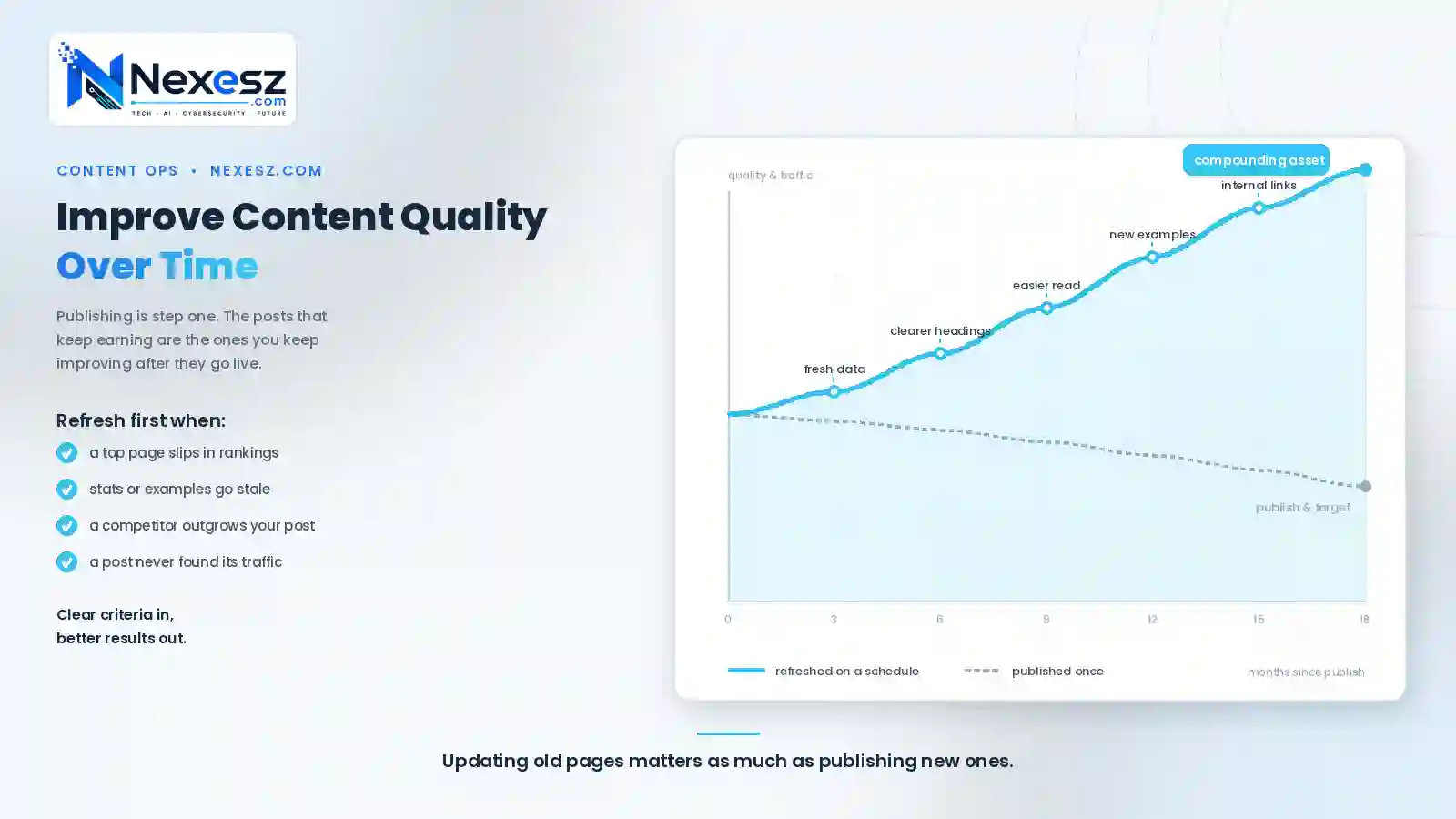
Creating valuable articles is a habit, not an event. After you publish, check your content regularly. Trends change, user needs change, and your numbers should change too.
The 2026 refresh data is the best argument I’ve found for doing this:
- Updated posts see a median 106% increase in organic traffic.
- Republished pages jump an average of 4.6 positions in the search results within six months.
- Content freshness has climbed to the sixth-largest Google ranking factor, up from effectively zero a few years ago.
- 52% of articles published before 2025 have never been refreshed — most of your competitors’ libraries are stale. That’s your opening.
One warning, because I keep seeing it: changing the publish date does nothing. Google rewards new information, not new dates. If the update doesn’t add something — a current statistic, a new example, a corrected recommendation — it’s theater.
Aim for a regular content refresh cycle: quarterly for fast-changing topics, yearly for evergreen ones. And prioritize smart. A page that used to rank and slipped is the fastest win, because Google already associates it with the topic.
Strong SEO writing combines helpful information with clear structure, every time:
- Write precise, descriptive headings.
- Keep paragraphs short.
- Use simple, plain language.
- Maintain a logical flow between sections.
- Optimize images with descriptive alt text.
- Include relevant internal links.
When you create content for search, focus on what users want instead of repeating keywords. That’s the entire skill, honestly.
Understand Quality Score in Google Ads
SEO and Google Ads are different games, but the overlap is real, and it’s worth your time.
Quality Score measures how relevant your keywords, ads, and landing pages are to each other, and the lesson transfers straight to organic: relevance between what the visitor wanted and what the page delivers is everything.
It also pushes you to make better landing pages — faster load times, clear calls to action, answers to the common questions — and that improves your ads and your organic results at the same time. A weak landing page will eat your traffic no matter how good the article is. If you’re packaging your own services around a blog, the skills-to-business guide covers how to apply that same discipline to a service business.
Content builds authority. Authority is what makes search engines — and the answer engines — treat your site as a reliable source.
Conclusion
If you’re using AI to create content, review it and make it your own before publishing. I don’t say that as a purist — I say it because the data is blunt about what happens when you don’t.
Then keep the loop going: know your audience, organize your ideas clearly, follow SEO best practices instead of chasing quick results, update your articles regularly, watch the numbers, and stay consistent with your publishing schedule. That’s it. There’s no secret.
By producing valuable content that genuinely helps readers, you improve search rankings, grow organic traffic, and build long-term authority. Start with one article today — research it properly, structure it clearly, and refresh it when the data tells you to.
Frequently Asked Questions
What is high-quality content?
Original, accurate, well-organized content made to answer users’ questions while giving real value — backed by first-hand experience that generic content can’t copy.
Why is high-quality content important for SEO?
It helps search engines understand your site, improves the user experience, and is the strongest on-page ranking signal in 2026. Pages with genuine E-E-A-T are the ones gaining rankings in core updates.
Can AI help create high-quality content?
Yes — for research, outlines, and first drafts. But you still edit by hand, verify facts, and add your own experience to keep the content original, accurate, and helpful.
How often should I update my website content?
Check your important pages every few months and update them whenever the information is old or what users want has changed. Pages left untouched for more than two years drift down on average; refreshed pages tend to climb.
How can I improve the quality of my blog posts?
Answer what the reader actually came to learn more completely than the top results do, add your own examples and experience, fix the on-page basics, and refresh the post with current data once a year.




Pingback: Retail Media Networks Examples: U.S. Guide (2026)
Pingback: Modern Online Business Guide: Build, Grow and Automate (2026)